One application. 8 lenders.
Apply Now One application routed to where you qualify.
Every Apply button starts the same single application. Your chosen lender is prioritized first.







| Secured loan | Installment loan | Home equity loan | |
|---|---|---|---|
| Rate range | 9.99% APR | 5.98 - 35% APR | 4 - 17.99% APR |
| Interest charged on | The full amount from day one | The full amount from day one | The full amount from day one |
| Repayment | Fixed installments, set end date | Fixed installments, set end date | Fixed installments, registered against the home |
| Re-borrow without reapplying | No | No | No |
| Best when | An asset can back the loan and cut the rate | You know the amount and want a payoff date | A large cost and meaningful equity in your home |
| Watch out for | The asset is at risk if payments stop | Interest on funds you may not need | Setup and legal costs; your home secures the debt |
Pledging an asset gets you three things: a lower rate, a larger amount, and an approval where an unsecured lender would decline. It costs you one thing, and it is the thing to understand before the rate: if you stop paying, the lender takes the asset.
In Canada the asset is almost always a home. All eight lenders listed lend against home equity, seven as a home equity loan or second mortgage and one, easyfinancial, as a secured personal loan from $15,000 to $150,000 at 9.99% over six to twenty years. If you were searching for a secured personal loan rather than a mortgage product, that is the one. A car you own outright secures a different product, on the car title loans page, and equipment secures its own financing on the equipment financing page.
The 35% federal cap changes the arithmetic. In a market without a ceiling, unsecured rates for poor credit run far above secured ones and pledging saves a great deal. In Canada an unsecured loan cannot cost more than 35%, so the gap is real but narrower, and the question is whether the saving is worth putting the asset at risk.
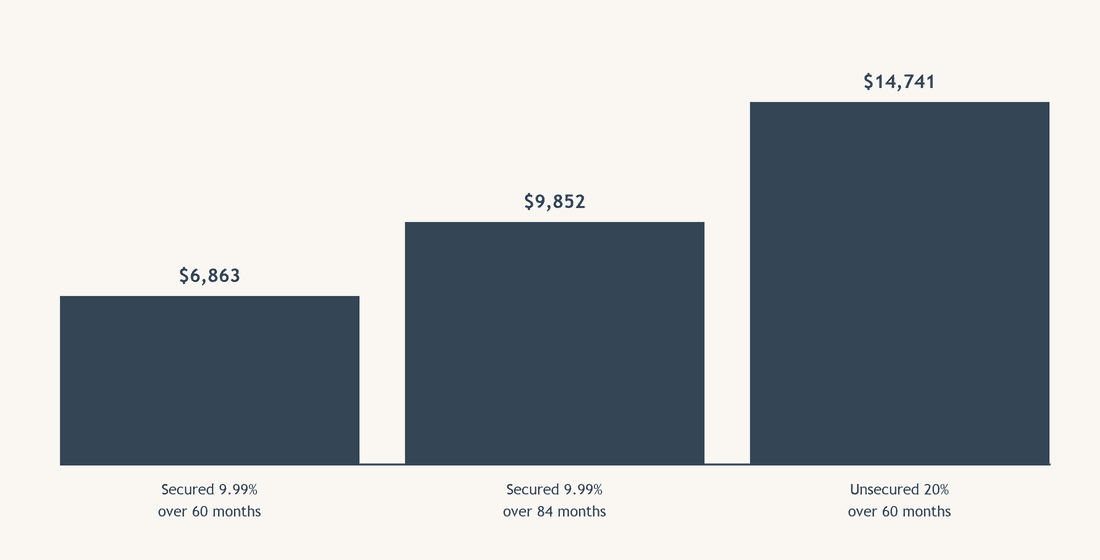
| $25,000 | Monthly payment | Total interest |
|---|---|---|
| Secured at 9.99% over 60 months | about $531 | about $6,863 |
| Secured at 9.99% over 84 months | about $415 | about $9,852 |
| Unsecured at 20% over 60 months | about $662 | about $14,741 |
Use the table to see the two things a secured loan does to the cost. The rate saving is large: about $7,900 less interest on $25,000 over five years at 9.99% against 20%. The longer term is the trap: stretch the same secured loan to seven years and the payment falls by $116 a month while the interest rises by $3,000. The secured loan is cheaper because the rate is lower, and only stays cheaper if the term stays short.
The 9.99% is the lowest rate easyfinancial publishes on its secured personal loan; the equity lenders publish lower, from 4.09%, with a full mortgage-style process behind it. One lender listed publishes 4%, but that is a reverse mortgage for homeowners over 55 with no monthly payment, and it is not a secured loan in the sense anyone searching this page means.
Less than it is worth, and the lender's number decides. Three things set it.
Loan-to-value. Most lenders go to 80% of a home's appraised value across every charge on it combined; a standalone line of credit is capped at 65%. On a $600,000 home with $300,000 owing, that is $180,000 of borrowing room, not the $300,000 you own.
Marketability. An asset that sells in a week is better security than one that takes a year, whatever it is worth, and the lender lends deeper against it.
Existing charges. Security registers in order, and an earlier interest outranks a later one. A secured loan behind an existing mortgage is second in line if the home is sold, and it is priced for that.
The asset. For the eight lenders listed, a home you own with equity in it: an appraisal, title, and a current mortgage statement.
Income of at least $1,200 to $1,500 a month depending on the lender, from any regular source; easyfinancial asks $1,200 and the seven equity lenders $1,500. The asset carries most of the weight, so the income bar is low.
Credit. Considered by all eight, decisive with none. All eight consider poor credit, because the asset is the security; a weak score moves you up the rate range and down the loan-to-value.
Time. Two of the eight fund within two days, easyfinancial and Nuborrow; six publish about a week, because the appraisal and the registration take time.
The lender enforces its registration: on a home, a power of sale or foreclosure after notice; on a vehicle, repossession. If the sale does not cover the balance, the shortfall is usually still owed. That is the whole difference between a secured and an unsecured default, and it is why the amount and the term matter more than the rate.
Two things to establish in writing before signing: what triggers default, in days, and whether notice is required before enforcement; and how and when the registration is discharged after the final payment, because a registration left in place blocks a future sale.
More often than the rate comparison suggests. If the amount is within reach of an unsecured lender, the asset is one you rely on, and the rate gap under the cap is modest, unsecured is the better structure at a higher rate: you are paying for the absence of an asset consequence. The personal loans page lists seventeen lenders, twelve of them considering a score under 560.
Secured borrowing earns its place when the amount is beyond unsecured reach, which on our platform is where home equity requests sit, at $48,393 on average against $5,888 for a personal loan, or when the rate gap over a long term is large enough to matter.
What can be pledged and how each asset is valued is on the collateral loans page, and every way of borrowing against a home is on the home equity loans page.
Reviewed by Vlad Sherbatov, Co-Founder and President, Smarter Loans. Last reviewed 17 September 2026. Lender figures are the lenders' published terms as checked August 2026; the unsecured comparison is illustrative. Platform figures cover applications from 1 January to 30 June 2026.

Secured Loans in Canada: How They Work
What a secured loan is, what you can pledge, how much cheaper it is than unsecured borrowing, and what happens if you cannot repay.
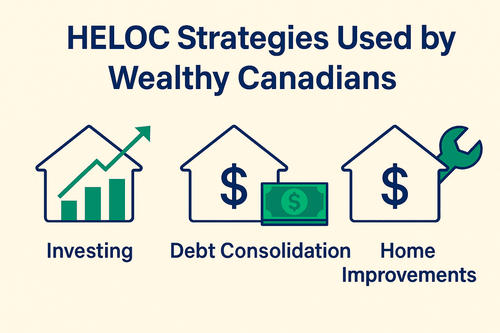
HELOC Strategies Canadians Use, and What They Risk
How Canadians borrow against home equity to invest, consolidate or hold liquidity, what each approach costs, and where the risk sits.
How Loan Interest Rates Are Set in Canada
What decides your personal loan rate in Canada, from the Bank of Canada rate to your credit band, and the moves that actually lower…
A loan with an asset pledged as security: the lender registers an interest in it and can take it if you default. In Canada the asset is almost always a home, and the eight lenders listed lend against home equity, seven as a home equity loan and one, easyfinancial, as a secured personal loan from $15,000 to $150,000 at 9.99% over six to twenty years.
Real but narrower than elsewhere, because the 35% federal cap limits unsecured rates. $25,000 over five years costs about $6,863 in interest at 9.99% secured against about $14,741 at 20% unsecured; stretch the secured loan to seven years and the saving shrinks by $3,000. The rate saves; the term decides whether the saving survives.
Yes. All eight lenders listed consider poor credit, because the asset carries the risk. A weak score moves you up the rate range and down the loan-to-value rather than to a decline. The lenders listed set a monthly income minimum of $1,200 to $1,500.
With the lenders listed, a home you own with equity in it. A car you own outright secures a car title loan, and equipment secures equipment financing, each on its own page. Investments and deposits are the cleanest security in principle, but no lender in the network currently lends against them.
The lender enforces its registration: sale of the home after notice, or repossession of a vehicle. If the sale does not cover the balance, the shortfall is usually still owed. Establish the default trigger and the discharge process in writing before you sign.