



On this page
What you need before you start
Consolidating with a personal loan is a short procedure, but it goes wrong when people start it without the numbers in front of them. The product itself is ordinary. A debt consolidation loan is a fixed-rate personal loan you happen to be using to clear other balances. Gather these first. All of it takes an afternoon, and having it ready is the difference between a quote and a guess.
- Every balance, with its rate and its minimum paymentInclude store cards and lines of credit, not just the obvious ones. You need the rate on each because the decision turns on the blended rate, not the worst one.
- Any early-payoff penalty on the debts you are clearingSome loans charge for being repaid ahead of schedule. That charge is part of what you need to borrow, and people routinely forget it and end up short.
- Proof of incomeRecent pay statements, or two years of filed returns if you are self-employed or on contract. Irregular income is not a barrier. Undocumented income is.
- Recent bank statements and government identificationMost lenders want two to three months of statements. Having them ready is the single biggest thing you control in how fast this moves.
- Your own credit reportPull it from Equifax or TransUnion before you apply, not after. Checking your own file is a soft inquiry and does not affect your score, and finding an error now is worth more than any negotiating later.
Debt consolidation is a common enough reason to borrow that it shapes the market you are shopping in. Across Smarter Loans personal loan applications, consolidation’s share moved from 12.4 percent to 10.6 percent between the year ending July 2025 and the year ending July 2026.
The five steps
- Total what you are consolidatingAdd the balances, plus any early-payoff penalties, plus the origination fee on the new loan. That sum is the loan amount you need, not the balances alone. Borrowing short means finishing with a loan and a leftover card balance, which is worse than where you started.
- Work out the rate you have to beatMultiply each balance by its rate, add those products, divide by the total balance. That weighted average is the number the new loan must come in under. Your worst card is not the benchmark.
- Get quotes, and compare them on APRCompare on annual percentage rate rather than the advertised rate, so mandatory fees sit inside the figure. Ask for the fee schedule in writing before you commit to anything. Applying through a comparison platform lets you see several lenders without collecting a hard inquiry from each of them.
- Clear each account in full, the day the money landsIn full, not partly, and immediately. Money that sits in a chequing account gets spent. Confirm each account reads zero rather than assuming the payment went through.
- Leave the accounts alone while the reporting settlesDo not close everything the moment it hits zero. Closing accounts shortens your credit history and cuts your available credit, which pushes your utilisation up at precisely the wrong moment. Keep one low-balance card open and reduce the limits on the rest instead.
Work out whether it saves you anything
The decision comes down to simple arithmetic, and you can do it in a few minutes once you have your balances in front of you. Here is what it looks like on three typical card balances. Your own numbers slot straight into the same sums.
What consolidating this example saves
| Total debt ($5,000 at 21.99%, $3,500 at 24.99%, $2,000 at 19.99%) | $10,500 at a blended 22.6% |
| Interest paying minimums only (about 27 years) | $18,496 |
| Same $10,500 as one installment loan at 13.95% over 36 months | $359 a month, $2,410 total interest |
| Difference | $16,086 less in interest |
Consolidating this example saves $16,086 in interest against paying minimums only.
Illustrative figures. Minimums modelled as interest plus 1% of the balance (or $10). The 13.95% consolidation rate is an assumption for the example, and your rate depends on your credit profile.
To run your own balances, use the debt payoff calculator.
What lenders check
Four things carry the decision on a consolidation loan, and how many debts you are combining is not one of them. Lenders are not assessing the tidiness of the arrangement. They are assessing whether the new payment gets made.
Documented, stable income. Not a particular figure. Evidence. Salaried employment is simplest, but contract, self-employed and commission income all work provided the paper trail is there.
Your debt-to-income ratio, with the new payment included. This is the share of gross monthly income already committed to debt. Lenders commonly want it around 40% or below once the consolidation loan is counted. Consolidating often improves this figure by itself, because one installment usually costs less per month than the several minimums it replaces.
Your credit profile. It sets the price more than the approval. Fair credit generally gets an approval at a higher rate. Poor credit narrows the field to lenders who specialise in it. There is no universal cut-off, which is why matching against real underwriting criteria beats guessing at a score threshold.
What the money is for. Some lenders will ask to see the balances and confirm the proceeds are clearing them. That is normal, and a consolidation stated honestly is a stronger application than a vague "personal expenses".
| Lender | Amount | Rate | Speed | |
|---|---|---|---|---|
| Cash Money | $500 to $10,000 | 34.99% APR | within 24 hours | See if you qualify |
| LendDirect | $100 to $15,000 | 34.99% APR | within 24 hours | See if you qualify |
| MDG Financial | $3,200 to $20,000 | 19.8 to 34.99% APR | within 24 hours | See if you qualify |
| Loan Away | $1,000 to $5,000 | 19.9 to 34.5% APR | within 24 hours | See if you qualify |
| Cash 4 You | $100 to $20,000 | 34.37% APR | within 24 hours | See if you qualify |
Consolidation Eligibility Checker
Check every box that applies to you. We'll give you an honest assessment.
The mistake that undoes it
Paying the cards off and then running them back up. This is the failure mode, and it is common enough that it is the main reason consolidation gets a mixed reputation. You clear five thousand dollars of card debt with a loan, the cards read zero, and over the following year the balances creep back. Except now you also have the loan. You have not consolidated your debt. You have doubled your credit capacity and used it.
The fix is mechanical, not moral: reduce the limits on the cards you have paid off, or freeze them, on the same day you clear them. If the credit is not available, it does not get used, and the loan actually finishes the job it was taken out to do.
When consolidating is the wrong move
It is not the answer to every debt problem, and the cases where it is not are worth naming plainly.
When the rate does not improve. If your balances are already cheap, like a student loan or a car loan at a promotional rate, folding them into a consolidation loan raises what you pay on them. Consolidate the expensive debt and leave the cheap debt where it is.
When a longer term wipes out the gain. A lower rate over seven years can cost more in total interest than a higher rate over three. Check total interest across the full term, not the monthly payment, before you decide the cheaper-looking option is cheaper.
When the debt is genuinely unpayable. Consolidation restructures debt you can service. If you cannot service it at any rate, the route designed for that is a consumer proposal, filed through a Licensed Insolvency Trustee. It reduces the balance rather than repricing it, and it stays on your credit file for years. Borrowing more to cover debt you cannot carry makes the eventual landing harder, not softer.
When the underlying cause is still running. If the balances built up because income does not cover outgoings, a consolidation loan buys time and nothing else. The debt-related share of Smarter Loans personal loan applications, consolidation plus paying off bills combined, moved from 53.8 percent to 45.4 percent between the year ending July 2025 and the year ending July 2026, which is a lot of Canadians reaching for the same tool. It works when it is the last step in a plan and not the first.
When you are ready to see real offers, one application matches your profile against multiple lenders without a separate hard inquiry from each.
Frequently asked questions
How do you use a personal loan for debt consolidation in Canada?
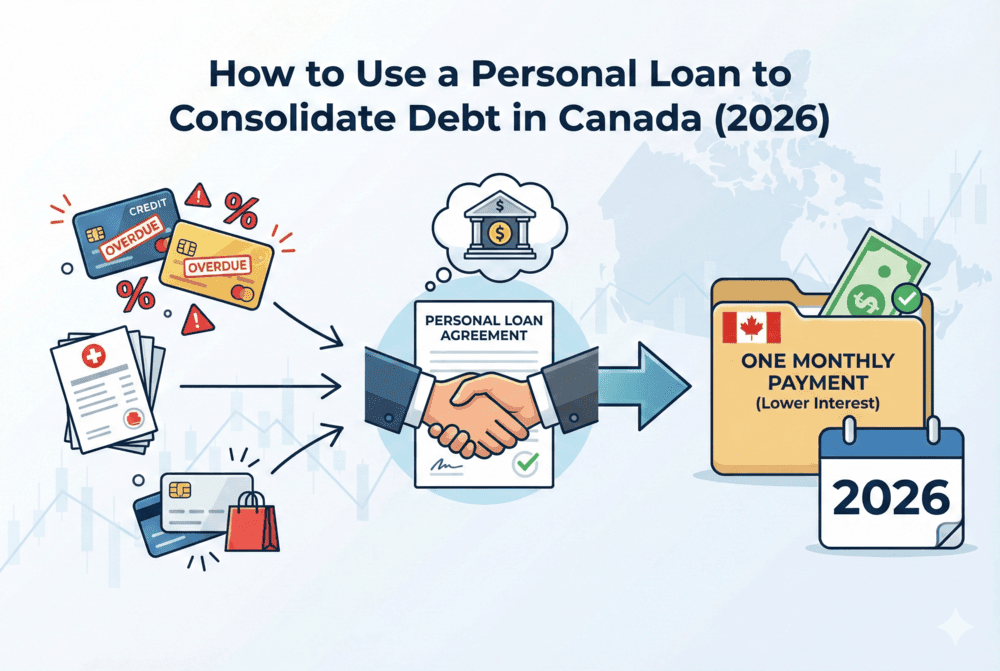
You apply for a personal loan large enough to cover the balances you want to combine, plus any early-payoff penalties and the loan's origination fee. When the funds arrive you pay each of those accounts off in full, immediately, and you are left with a single installment at a fixed rate with a fixed end date. The loan is an ordinary personal loan. Most lenders do not sell a separate "consolidation" product, they simply lend and you use the proceeds for this purpose.
How do you get approved for a consolidation loan without collateral?
Most consolidation loans are unsecured, so no collateral is the normal case rather than the exception. Approval then rests on documented income, your debt-to-income ratio once the new payment is included, and your credit profile. If you are struggling to get an unsecured approval, the options are a co-signer, a secured loan against an asset such as a vehicle, or a smaller loan that consolidates only your most expensive balances rather than all of them.
How do you apply for a consolidation loan without hurting your score?
Applying to several lenders one at a time collects a hard inquiry from each, and a cluster of them reads as urgency. Two things reduce that. First, check your own credit before applying. That is a soft inquiry with no effect. Second, use a platform that matches your profile against multiple lenders from a single application rather than submitting separately to each. The inquiry itself is a small, temporary effect in any case. The larger score movement comes later, when your utilisation falls as the cards clear.
What debt can you consolidate?
Unsecured consumer debt is the usual candidate: credit cards, store cards, lines of credit, other personal loans, payday loans, and outstanding bills in collections. Secured debt generally cannot be folded in, because the lender's claim is on an asset. A mortgage or a car loan is refinanced rather than consolidated. Student debt is technically possible but usually a bad idea, since government student loans carry protections and repayment flexibility that an ordinary personal loan does not.
Sources
- Financial Consumer Agency of Canada, consolidating your debt, for the definition of each consolidation route.
- Office of the Superintendent of Bankruptcy, consumer proposals and Licensed Insolvency Trustees, for the insolvency route named above.
- Smarter Loans personal loan applications, August 2024 to July 2026, for the two first-party share figures on this page. Each carries its period in the sentence it appears in.
Related reading: debt consolidation loans in Canada compared and how debt consolidation works in Canada. To check the arithmetic against a longer horizon, use the debt payoff calculator.

 Written by:
The Smarter Loans Editorial Team produces in-depth, original content to help Canadians navigate borrowing, credit, and personal finance with confidence.