One application. 8 lenders.
Apply Now One application routed to where you qualify.
Every Apply button starts the same single application. Your chosen lender is prioritized first.


The price is fixed by law, and every lender listed charges it: $14 for every $100 you borrow, in every province that licenses payday lending. Borrow $300 and you repay $342 on your next pay date. Borrow $500 and you repay $570.
That fee is not an interest rate, and the difference matters when you compare it to anything else. Fourteen dollars on a hundred for two weeks is 14% for two weeks; the same cost across a year is about 365%. A personal loan at the federal cap of 35% APR is the most expensive loan a licensed lender can make, and a payday loan costs roughly ten times that per dollar per day. That is legal because the federal cap of 35% carries a specific exemption for payday loans up to $1,500, capped at $14 per $100, in force since January 2025.
None of that makes a payday loan the wrong product. For $300 you will repay in full on Friday, $42 is the whole cost and there is nothing cheaper you can get in an hour. It makes it the wrong product for anything you cannot repay in full on the date, which is the next section.
Use one test. If you can repay the whole amount, plus the fee, on your next pay date without borrowing again, a payday loan does what it says. If you cannot, the fee repeats, and a second loan to cover the first is how a $300 problem becomes a $600 one.
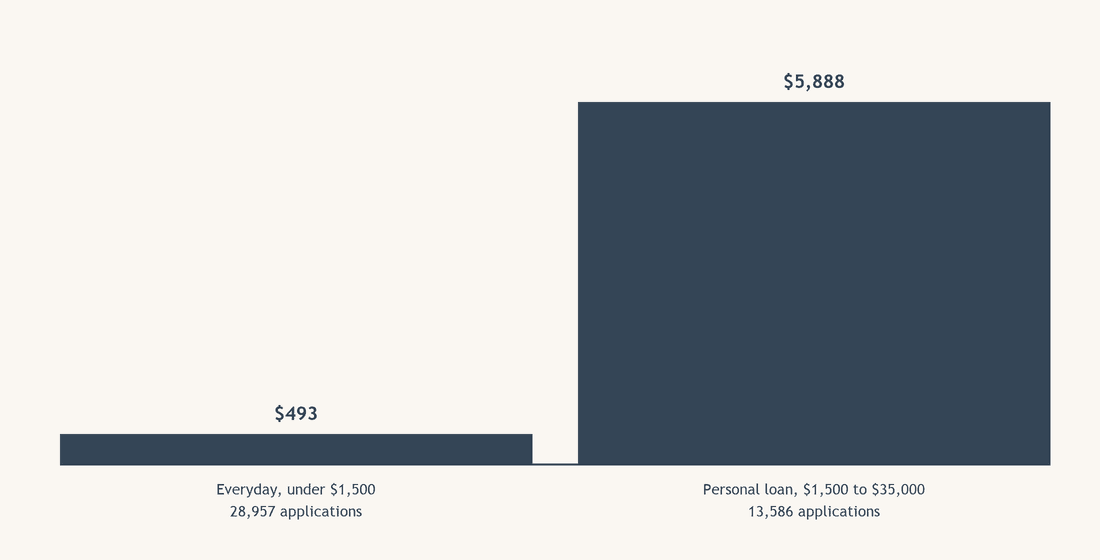
| Segment | Applications | Average request |
|---|---|---|
| Everyday, under $1,500 | 28,957 | $493 |
| Personal loan, $1,500 to $35,000 | 13,586 | $5,888 |
On our platform, from January 2026 to June 2026, requests under $1,500 averaged $493. At that size the honest comparison is between a payday loan and three other products that the same application reaches:
The application below reaches all of them. Enter the amount you need and how you will repay it, and it routes to the lender whose product fits rather than to the payday lender by default.
Every province that licenses payday lending caps the cost at the same figure. What differs is who is allowed to lend, what they must tell you, and what happens on a repeat loan.
| Province | Maximum cost | Payday lending |
|---|---|---|
| Ontario | $14 per $100 | Licensed |
| British Columbia | $14 per $100 | Licensed |
| Alberta | $14 per $100 | Licensed |
| Manitoba | $14 per $100 | Licensed |
| Saskatchewan | $14 per $100 | Licensed |
| Nova Scotia | $14 per $100 | Licensed |
| New Brunswick | $14 per $100 | Licensed |
| Newfoundland and Labrador | $14 per $100 | Licensed |
| Prince Edward Island | $14 per $100 | Licensed |
| Quebec | 35% credit rate | No conventional payday lending; the province licenses no lender above 35% |
Provincial payday regulations and the federal Criminal Interest Rate Regulations, checked August 2026. The territories have no payday regime.
Two rules travel with the cap in most provinces. A lender cannot roll one payday loan into another, so a repeat loan is a new loan with a new fee, not an extension. The Financial Consumer Agency of Canada sets out what a payday lender must tell you before you sign.
Quebec is the exception in every direction. With no licence available above a 35% credit rate, there is no conventional payday lending in the province, and small borrowing there runs through installment products with higher minimums.
Less than for any other loan, which is the trade for the price.
A regular income and a bank account it is paid into. Every lender listed publishes a minimum monthly income: $800 at the lowest, $1,500 for three of the eight, $2,000 at the highest. The source matters less than the regularity; benefit income counts with most of these lenders where it arrives on a fixed date.
No minimum credit score, at six of the eight. All eight consider poor credit, and six publish no minimum at all. On our platform, 71.5% of everyday-scale applicants sit below a 660 score, and 25.7% have no usable score; this is the product built for that file.
Online banking access. The decision is made on your recent bank statements, read directly, and the repayment is taken from the same account on your pay date. That is why the decision is fast and why you should know your pay date before you apply.
Age of majority and a provincial address in a province that licenses payday lending.
There is no interview, no employment letter, and usually no phone call. The cost of that convenience is the fee, and the fee is the same whether you ask for $100 or $1,500.
Seven of the eight lenders listed pay out within 24 hours of approval, and two publish payout within the hour. What decides which side of that you land on is the clock, not the lender.
An e-transfer sent before your bank's cutoff arrives the same afternoon; one sent after it arrives the next morning. Apply before noon with your online banking login ready and the decision, the agreement and the deposit can all happen in one sitting. Apply at 9pm and the money is there for breakfast. The express loans page covers the cutoff times lender by lender.
Speed does not cost more with a payday lender, because the price is fixed; it is the one product where the fastest option and the slowest cost the same.
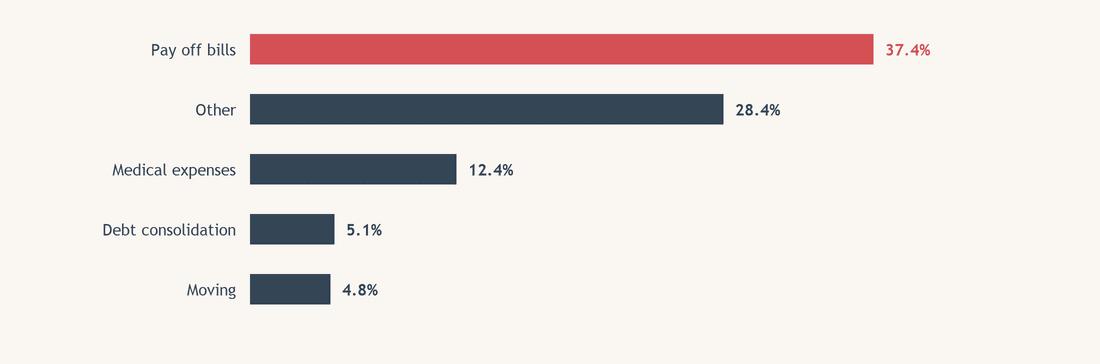
| Purpose | Share of everyday requests |
|---|---|
| Pay off bills | 37.4% |
| Other | 28.4% |
| Medical expenses | 12.4% |
| Debt consolidation | 5.1% |
| Moving | 4.8% |
Use the figures below to check your own reason against what other people borrow for, because the purpose decides whether the product fits. Paying off bills leads at 37.4% of everyday requests on our platform: a bill with a due date and a pay date a week later is the case a payday loan was designed for. Medical expenses at 12.4% are the third-largest reason, and a dental bill that can be paid in two weeks fits the same way.
Debt consolidation at 5.1% is the reason that does not fit. A payday loan cannot consolidate anything; it adds a fee to a balance that already exists, and the debt consolidation page is where that request belongs.
Who applies matters too. Half of everyday-scale applicants declare full-time employment; 15.5% declare disability income and 12.5% social assistance, both of which count with most lenders listed where they arrive on a fixed date. The average request rises with age, from $442 for applicants under 25 to $604 for applicants 65 and over.
Source for all platform figures: Smarter Loans everyday-scale loan applications under $1,500, January 2026 to June 2026, status Applied.
Our guide to how payday loans work in Canada covers the alternatives in more detail, and every other personal product is on the personal loans page.
Reviewed by Vlad Sherbatov, Co-Founder and President, Smarter Loans. Last reviewed 15 September 2026. Platform figures cover applications from 1 January to 30 June 2026.
How Payday Loans Work in Canada
How payday loans are priced, the $14 per $100 fee cap, what happens if you cannot repay, your rights, and the cheaper alternatives to…
What Canadians Ask For When They Borrow Small
71 percent of more than 79,000 Smarter Loans personal loan applications in the year to July 2026 asked for $1,500 or less. The average request in that range was $552, and it barely moves across income types or provinces.

Top Payday Loan Alternatives in Canada
Cheaper alternatives to payday loans in Canada: installment loans, credit union loans, cash advances and payroll advances, with the real cost of each.
Are Payday Loans Ever a Good Idea? A Canadian Perspective
Considering a payday loan? Learn when they make sense, the real costs involved, and better alternatives for Canadians facing financial emergencies.
$14 for every $100 borrowed, in every province that licenses payday lending, and every lender listed charges exactly that. Borrow $300 and you repay $342 on your next pay date. As an annual rate that is about 365%, which is legal because the 35% federal cap carries a specific exemption for payday loans up to $1,500.
Yes. All eight lenders listed consider poor credit and six publish no minimum score at all; the decision is made on your bank statements and your pay date. On our platform, 71.5% of everyday-scale applicants sit below a 660 score, which is the population the product serves.
Seven of the eight lenders pay out within 24 hours of approval and two within the hour. The clock decides more than the lender: apply before your bank's e-transfer cutoff with your online banking login ready and the money can arrive the same afternoon.
Not in the conventional form. Quebec licenses no lender above a 35% credit rate, which rules out the $14 per $100 payday model; small borrowing in the province runs through installment products with higher minimums. Every other province with a payday regime caps the cost at $14 per $100.
Usually, if you cannot repay in full on your next pay date. A cash loan or short-term loan repaid over two or three months is priced under the 35% cap; $500 over three months costs roughly $29 in interest against $70 for a two-week payday loan. One application reaches both kinds of lender and routes on the amount and how you plan to repay.