One application. 7 lenders.
Apply Now One application routed to where you qualify.
Every Apply button starts the same single application. Your chosen lender is prioritized first.







Four structures, and choosing the wrong one is the most common expensive mistake in renovation borrowing.
A home equity loan or second mortgage. A lump sum with fixed payments, registered behind your existing mortgage, which it leaves alone. Suits a written quote with a known total. Five of the seven lenders listed finance renovations this way, from 4.09%.
A home equity line of credit. A limit you draw as the project progresses, interest only on what is out. Suits a staged renovation with an uncertain final cost, which is why contractors see it used so often. Capped at 65% of the home's value on its own.
A refinance. Replacing your mortgage with a larger one at the best rate of the four, and triggering the penalty on the mortgage it replaces. Worth it on a project large enough that the rate saving beats the penalty; the mortgage refinancing page runs that arithmetic.
An unsecured personal loan. No appraisal, no charge on the home, fast, at a higher rate and a smaller amount. Suits a small job with a known cost; the personal loans page lists seventeen lenders.
The rule: staged and uncertain wants a line; known and one-time wants a fixed loan; large enough to justify a penalty wants a refinance; small and quick wants a personal loan.
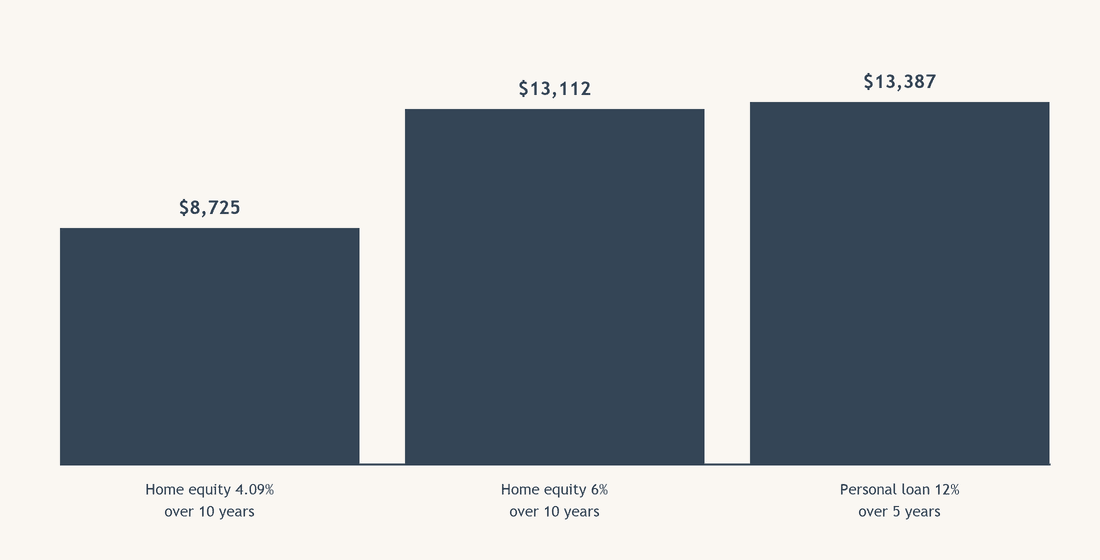
| $40,000 renovation | Monthly payment | Total interest |
|---|---|---|
| Home equity loan at 4.09% over 10 years | about $406 | about $8,725 |
| Home equity loan at 6% over 10 years | about $443 | about $13,112 |
| Personal loan at 12% over 5 years | about $890 | about $13,387 |
Use the figures to price the structure against the project. On $40,000 the equity route at the lowest published rate costs about $4,700 less in interest than a personal loan and less than half the monthly payment, because the home is the security and the term is longer. The personal loan clears in five years and puts nothing at risk; the equity loan is cheaper every month and registers a charge on your home. Both are honest choices; the amount usually decides.
The 4.09% floor is 8Twelve's published renovation rate. One lender listed publishes a lower figure, 4%, but it is a reverse mortgage for homeowners over 55 with no monthly payments, and it is not a renovation product; the honest floor for a renovation borrower making payments is 4.09%. The mortgage payment calculator runs any amount, rate and term.
Five of the seven publish a renovation product or name renovations as a use of their equity products. 8Twelve Mortgage publishes a dedicated renovation mortgage and a purchase-plus-improvements mortgage that finances the home and the work in one loan. Spring Mortgages publishes home renovation financing against up to 80% of the home's value. Lotly, Nuborrow and Canadalend each name renovations as a use of their home equity and refinance products. Homewise publishes no renovation use, and Bloom's product is a reverse mortgage.
Our application asks what the project is, whether the cost is fixed, and how far along it is, and routes on the answers.
Sometimes, and the borrowing should not assume it. Kitchens, bathrooms and anything correcting a deficiency, a roof, a foundation, a furnace, tend to return the most of their cost at resale. Highly personal finishes, pools, and over-improvement relative to the street tend to return the least.
That is not a reason not to do the work. It is a reason to size the borrowing to what you can carry rather than to what the house might be worth afterwards. On our platform, homeowners borrowing against equity ask for $48,393 on average, and personal-loan applicants borrowing for home improvement ask for $7,925: the equity route is for the kitchen, the personal loan for the bathroom.
On a larger project the money does not arrive at once, and two mechanisms shape the cash flow.
Progress draws. The lender releases funds as defined stages complete, usually with an inspection before each release. Budget for the gap between paying a trade and the draw arriving; that gap is what a contingency is for.
The construction lien holdback. Provincial legislation requires you to hold back a percentage of each payment, 10% in Ontario, for a set period after substantial completion, protecting your title against a subtrade who was not paid registering a lien. A contractor who asks for full payment upfront is asking you to carry the risk the holdback exists to manage.
A lender will ask for most of this, and a contractor who cannot supply it is telling you something. Five things, and the contingency is the one most people skip.
Every way of borrowing against a home is on the home equity loans page, and borrowing against other assets on the secured loans page.
Reviewed by Rafael Rositsan, Co-Founder and CEO, Smarter Loans. Last reviewed 16 September 2026. Lender figures are the lenders' published terms as checked August 2026. Platform figures cover applications from 1 January to 30 June 2026.

Using a Personal Loan for Home Renovations in Canada
When an unsecured loan beats borrowing against your home for renovations, what Canadians request, and how to size the loan to the job.
Budget Renovations With the Highest Return in Canada
Which affordable renovations actually add resale value in Canada, what they cost, and how to fund one without overborrowing.
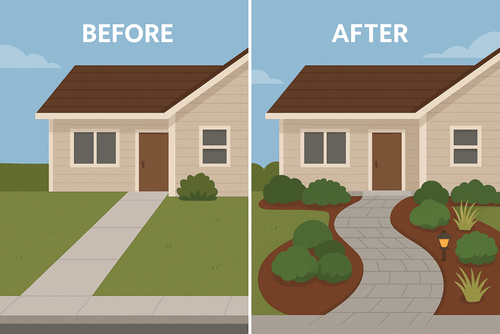
Landscaping That Adds Property Value in Canada
Which landscaping work adds resale value in Canada, what to skip, how the seasons affect timing and cost, and how to fund a larger…
A line for a staged project with an uncertain final cost, drawing as you go and paying interest only on what is out; a fixed home equity loan for a written quote with a known total. A refinance for a project large enough to justify the penalty on your existing mortgage; a personal loan for a small job with no charge on the home.
On $40,000 over ten years, about $406 a month and $8,725 in interest at 4.09%, the lowest published renovation rate among the lenders listed; about $443 and $13,112 at 6%. The same $40,000 as a personal loan at 12% over five years is about $890 a month and $13,387 in interest, with no charge on the home.
Five of the seven. 8Twelve publishes a dedicated renovation mortgage and a purchase-plus-improvements mortgage; Spring Mortgages publishes renovation financing to 80% of the home's value; Lotly, Nuborrow and Canadalend name renovations as a use of their equity products. Homewise publishes no renovation use, and Bloom's product is a reverse mortgage.
Some do, many do not. Kitchens, bathrooms and deficiency corrections return the most; personal finishes, pools and over-improvement for the street return the least. Size the borrowing to what you can carry, not to what the house might be worth afterwards.
A percentage of each payment, 10% in Ontario, that you must hold back for a set period after substantial completion, protecting your title against an unpaid subtrade registering a lien. A contractor asking for full payment upfront is asking you to carry the risk the holdback manages.