One application. 7 lenders.
Apply Now One application routed to where you qualify.
Every Apply button starts the same single application. Your chosen lender is prioritized first.







| Mortgage refinance | Home equity loan | Line of credit | |
|---|---|---|---|
| Rate range | 4 - 17.99% APR | 19.8 - 34.99% APR | |
| Interest charged on | The full new balance, amortized | The full amount from day one | Only what you draw |
| Repayment | Replaces your existing mortgage | Fixed installments, registered against the home | Revolving, minimum payment |
| Re-borrow without reapplying | No | No | Yes |
| Best when | Rates or your equity have moved in your favour | A large cost and meaningful equity in your home | Costs arrive over time and you cannot size them yet |
| Watch out for | Breakage penalties on the mortgage you replace | Setup and legal costs; your home secures the debt | No end date means a balance can persist for years |
That is the question a refinance answers, and everything else is arithmetic. Breaking a mortgage before the end of its term costs a penalty, and the penalty depends on which kind of mortgage you have.
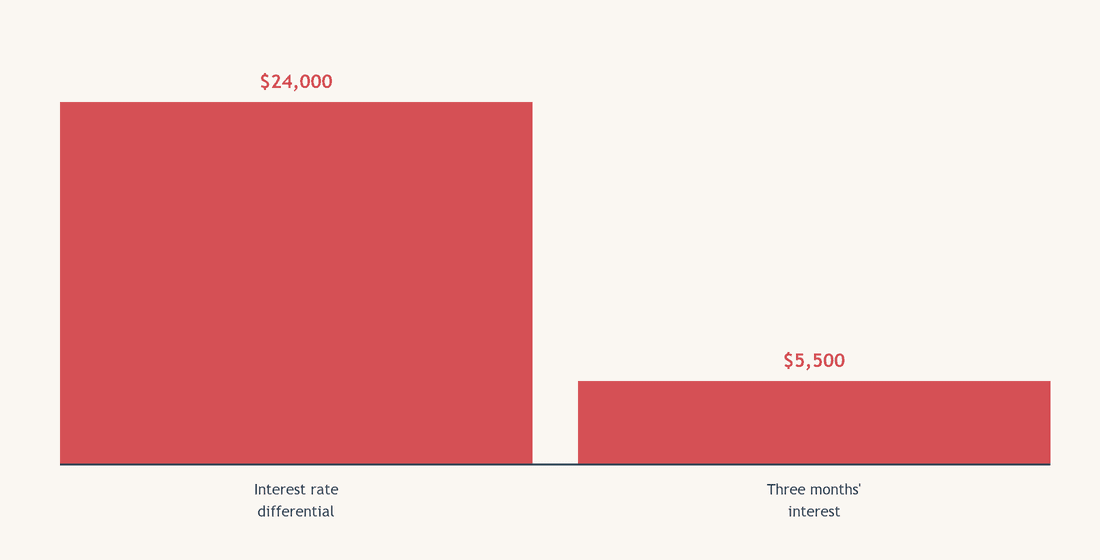
| Illustrative penalty, $400,000 remaining, three years left | |
|---|---|
| Fixed rate, interest rate differential: contract 5.5%, lender's comparable rate 3.5% | about $24,000 |
| Variable rate, three months' interest at 5.5% | about $5,500 |
Use the figures as a shape, not a quote. A variable mortgage is usually penalised three months' interest. A fixed mortgage is penalised the greater of three months' interest or the interest rate differential, which is the gap between your rate and the lender's current rate for the time you have left, on the whole balance, and on a large balance with years remaining it runs to five figures. Lenders calculate the differential differently, and estimates vary widely from the discharge statement.
Get the exact figure in writing from your current lender before you do anything else. The Financial Consumer Agency of Canada explains how the two penalties are calculated and how to reduce them.
Four situations, and the first needs the real penalty figure in hand.
The rate saving beats the penalty plus costs. Across the remaining term, on the whole balance. Straight arithmetic, and the mortgage payment calculator runs it once you have the penalty.
You are consolidating expensive debt. Card balances at 20% moved into a mortgage at 5% or 6%. The next section covers why this is both the best and the most dangerous reason.
You are taking equity out for something with a return, or at a cost lower than the alternative borrowing: a renovation, a business, a purchase you would otherwise finance at a higher rate.
The amortisation has to change. Cash flow has changed and the payment has to come down, which a longer amortisation does at a cost in total interest.
A fifth case is not a refinance at all: if your term is ending, moving to a new lender at renewal carries no penalty, and the Financial Consumer Agency of Canada covers how a renewal differs from a break.
Up to 80% of your home's appraised value, across every mortgage on it combined, with federally regulated lenders. On a $600,000 home with $300,000 owing, that is a new mortgage of up to $480,000 and $180,000 in your hand. Above 80%, a refinance is not available; a second mortgage or a home equity loan behind your existing mortgage is the route, which also leaves your first mortgage and its rate alone.
Six of the seven lenders listed refinance: 8Twelve, Nuborrow, Canadalend, Clover Mortgage, Homewise and nesto each publish it on their own sites, from 4.04% at the lowest published rate. Three of the seven decide within two days; the appraisal, the discharge and the legal registration take two to four weeks after that.
Sometimes, and it should be a decision rather than a side effect.
Moving $30,000 of card balances at 20% into a mortgage at 5% cuts the rate by three quarters. It also stretches the debt. Paid over three years on the cards, that $30,000 costs about $10,137 in interest; added to a 25-year mortgage at 5%, it costs about $22,344, because it takes twenty-five years to clear. Paid down over five years inside the mortgage, it costs about $3,926, which is the version that actually saves money.
The arithmetic says: consolidate, then pay the consolidated amount down fast, and keep the cards at zero. Two more things it does not say. Unsecured debt becomes debt secured against your home, which is a change in risk and not only in rate. And a refinance to consolidate carries the penalty above, which has to be paid for by the saving. Our debt consolidation page covers the unsecured route where the penalty makes the mortgage route lose.
Together, a few thousand dollars before the penalty. Every one belongs on the same sheet as the rate saving.
Your current mortgage statement, showing balance, rate, term end and the lender's penalty calculation.
The property, with an appraisal the new lender orders.
Income, documented the way the tier you are refinancing with accepts: tax slips for a bank or A lender, bank statements for a B lender. Every lender listed publishes a $1,500 monthly minimum; the tier decides what proves it.
Credit, considered by all seven, decisive with none; it sets the tier and the rate. All seven consider poor credit.
Equity, since the 80% limit is on the whole mortgage, not the new money.
Every tier of mortgage lending is on the mortgage lenders page; a second mortgage or a line that leaves your first mortgage alone is on the home equity loans page.
Reviewed by Rafael Rositsan, Co-Founder and CEO, Smarter Loans. Last reviewed 16 September 2026. Lender figures are the lenders' published terms as checked August 2026; the penalty and consolidation examples are illustrative.
On a variable mortgage, usually three months' interest. On a fixed mortgage, the greater of three months' interest or an interest rate differential, which on $400,000 with three years left and a two-point rate gap is roughly $24,000. Lenders calculate it differently, so get the exact figure in writing before deciding anything.
80% of the appraised value across every mortgage on the home, with federally regulated lenders. On a $600,000 home with $300,000 owing, up to $180,000 in new borrowing. Above 80%, a second mortgage or home equity loan is the route.
Six of the seven: 8Twelve, Nuborrow, Canadalend, Clover Mortgage, Homewise and nesto each publish mortgage refinancing on their own sites, from 4.04% at the lowest published rate. Three of the seven decide within two days; the appraisal and legal work take two to four weeks after that.
Only if you pay the consolidated amount down fast. $30,000 of card debt at 20% costs about $10,137 in interest over three years; the same $30,000 spread over a 25-year mortgage at 5% costs about $22,344. Paid down over five years inside the mortgage it costs about $3,926, and that is the version that saves money.
Only if the saving across the remaining term exceeds the penalty plus the appraisal, legal, discharge and any lender fee. If your term is ending, switching lenders at renewal carries no penalty and is usually the better route.