One application. 8 lenders.
Apply Now One application routed to where you qualify.
Every Apply button starts the same single application. Your chosen lender is prioritized first.








Anything a lender can take, value and sell if you do not repay. Five kinds come up, and they are lent against very differently.
Real property. A home, a cottage, a rental. The deepest lending and the lowest rates, because the value is stable and the market for it is always there. Every lender listed lends against a home.
Vehicles. A car, a truck, a boat you own outright. Lent against a discount to the vehicle's wholesale value, over a shorter term, because it loses value every month. The lenders for a car you own are on the car title loans page.
Equipment. Machinery, trucks and tools a business owns. Lent against resale value, and only where a resale market exists; the lenders are on the equipment financing page.
Investments and cash deposits. The cleanest collateral of all, because the value is not in question. Banks and investment dealers lend against them; no lender in the Smarter Loans network currently does.
Inventory and receivables. Business assets, lent against by working capital and factoring lenders on the business loans page.
The eight lenders listed lend against a home. That is the honest scope of the cards above; the rest of what follows is about how collateral works whichever asset it is.
A share of the value, not the value, and the share follows how easily the asset sells.
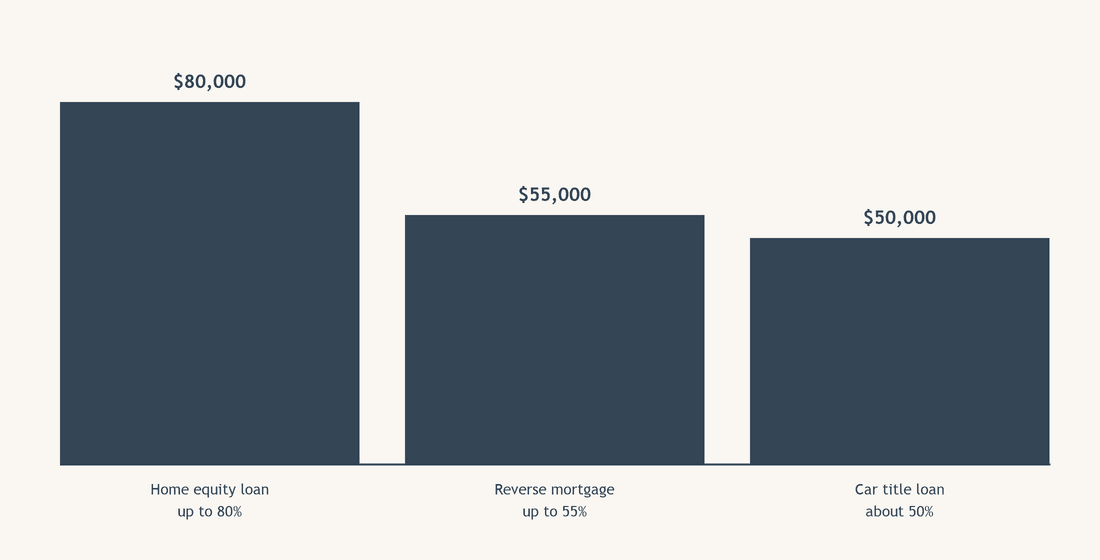
| $100,000 of asset value | What a lender in the network lends against it |
|---|---|
| A home, home equity loan | up to 80% across all mortgages, $80,000 |
| A home, reverse mortgage at 55 or over | up to 55%, $55,000 |
| A car you own outright, car title loan | about 50% of wholesale value, $50,000 |
Use the table to see why the same dollar of value borrows differently. A home lends deepest because it holds its value and sells; a car lends at half because it is losing value while the loan runs and sells for less than retail when a lender has to move it. Equipment sits between, depending on the resale market for the specific machine.
Three things move the share. The appraisal is the lender's, and it is usually lower than the owner's estimate. Existing charges register in order, so a loan behind an existing one lends less. And the borrower's credit, which does not decide the approval on secured lending, still moves the share and the rate.
The rate saving is the reason to do it, and the consequence is the reason to think first.
The saving. A home equity loan from the lenders listed starts at 4.09%; an unsecured personal loan for a borrower with the same credit can run to the 35% cap. On a large amount over a long term the difference is tens of thousands of dollars.
The consequence. A default on unsecured debt damages your credit. A default on secured debt damages your credit and costs you the asset, and if the sale does not cover the balance the shortfall is usually still owed. For a home that means a power of sale or foreclosure; for a car it means repossession of the thing you drive to work.
The deliberate cases. Pledging makes sense when the amount is beyond what an unsecured lender will give, when the rate gap is large enough to matter over the term, and when the asset is not one your daily life depends on. It makes less sense when the borrowing is short-lived, when the amount is within unsecured reach, or when the asset is the car that earns the income that repays the loan.
The registration is what makes the pledge real. Security on a home is registered on title; security on a vehicle, equipment or any other personal property is registered under the province's personal property security legislation, in Ontario through the Personal Property Security Registration system. Two things follow.
Priority runs by registration order, not by agreement date. An interest registered first outranks one registered later, whatever the documents say.
A registered interest follows the asset, not the borrower. Selling a pledged car without discharging the lien passes the lien to the buyer, which is why a lien search is the first step in any private purchase and why the Financial Consumer Agency of Canada tells buyers to search before they pay.
The discharge is the other end of the same fact. When the loan is repaid the lender must remove the registration; a registration left in place blocks a sale or a refinance years later, and confirming the process before you sign is worth the question.
The network lists lenders by what they take as security, so the asset decides where the application goes.
A home routes to the eight lenders listed, and to secured loans, from 4.09%, with the full appraisal and registration process behind it. Over 55 and wanting income without payments, the reverse mortgage lenders lend to 55%.
A car you own outright routes to the two car title lenders, at about half the vehicle's wholesale value, from 9% to the 35% cap, in five provinces.
Business equipment or a truck routes to the seven equipment financing lenders, from 5.5%, with the term matched to the machine's working life.
Investments, deposits, receivables have no lender in the network today; a bank or investment dealer lends against the first two, and a factoring lender against the third on the business loans page.
The product page for borrowing against a home is secured loans, and every way of using home equity is on the home equity loans page.
Reviewed by Rafael Rositsan, Co-Founder and CEO, Smarter Loans. Last reviewed 17 September 2026. Lender figures are the lenders' published terms as checked August 2026.
A home, a vehicle you own outright, business equipment, investments or cash deposits, and business inventory or receivables, each lent against at a share of its value that follows how easily it sells. The eight lenders listed lend against a home; a car routes to car title loans and equipment to equipment financing.
A share of the value, not the value. Up to 80% of a home across all mortgages, up to 55% on a reverse mortgage, about half a car's wholesale value on a title loan. The lender's appraisal sets the base, and existing registered charges reduce the share.
No. It moves the rate and the amount, and every lender listed considers poor credit because the asset carries the risk, but ability to repay is still assessed and a weak score moves you up the rate range and down the loan-to-value.
The lender takes and sells the asset: a home after notice through power of sale or foreclosure, a vehicle by repossession. If the sale does not cover the balance, the shortfall is usually still owed. That consequence is the price of the lower rate.
Usually. Home-secured lending from the lenders listed starts at 4.09% against up to 35% unsecured. The saving is largest on big amounts over long terms; on a small, short loan within unsecured reach, paying the higher rate to keep the asset out of it is often the better trade.