One application. 2 lenders.
Apply Now One application routed to where you qualify.
Every Apply button starts the same single application. Your chosen lender is prioritized first.


| Reverse mortgage | Home equity loan | Bank mortgage | |
|---|---|---|---|
| Rate range | 6.56% APR | 4 - 17.99% APR | 3.45 - 16% APR |
| Interest charged on | The advanced amount, compounding until the home sells | The full amount from day one | The full amount, amortized |
| Repayment | None required while you live in the home | Fixed installments, registered against the home | Fixed or variable payments over the amortization |
| Re-borrow without reapplying | Draws up to your approved limit | No | No |
| Best when | You are 55+ with equity and want no monthly payments | A large cost and meaningful equity in your home | You qualify on income and credit at a bank or monoline |
| Watch out for | Interest compounds against your equity over time | Setup and legal costs; your home secures the debt | Qualification is strictest here |
Two conditions, and both lenders listed apply the same ones: you are 55 or over, and you own the home you live in. If there is a mortgage on it, the reverse mortgage pays it off first and you take what is left.
How much you can take is set by three things: your age, the home's appraised value, and where it is. Both lenders cap the amount at 55% of the home's value, and the older you are the closer to that cap you can get, because the lender is estimating how long the loan will run before the home is sold. A 60-year-old in a small town is offered a smaller share than a 75-year-old in Toronto.
There is no income test worth the name and no credit test that decides anything, because you make no payments. One lender publishes a $1,500 monthly income minimum; the other publishes none. That is the point of the product: it turns a home into cash for people whose income would not support a loan payment, which is also its cost.
Two lenders in the Smarter Loans network offer one, and the rate is where they differ most.
| Bloom | CHIP | |
|---|---|---|
| Rate from | 6.56%, fixed terms only | 7.29%, fixed or variable |
| Amount | $20,000 to $2 million | $25,000 to $10 million |
| Provinces | Ontario, British Columbia, Alberta | Every province and territory |
| Setup fees | $2,300 published: processing $1,650, appraisal $350, legal advice $300 | Appraisal, legal and administrative fees named, not priced |
| Funding | About 30 days | About 30 days |
Use the table to see which lender can serve you at all before comparing rates. If you are in Ontario, BC or Alberta you have a choice and the cheaper rate is worth roughly three quarters of a point a year for the life of the loan; anywhere else, one lender serves you.
The rate is only half the cost. The other half is time. Because you make no payments, every month's interest is added to the balance and the next month's interest is charged on the larger amount. That is compounding, and on a loan that may run fifteen or twenty years it is the whole story.
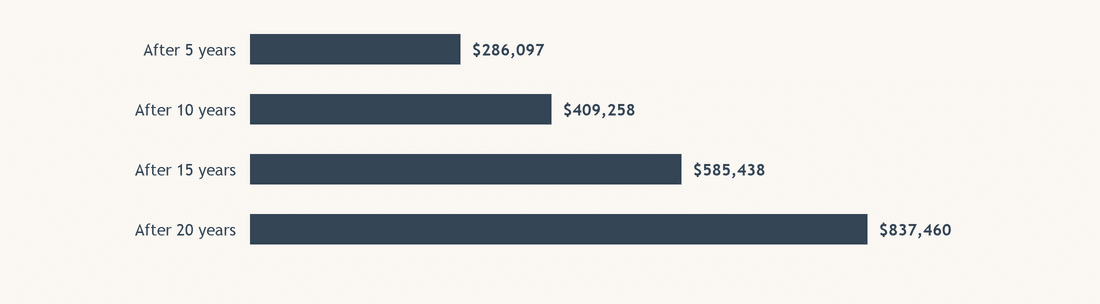
| Years with no payments | Balance owed on $200,000 at 7.29% |
|---|---|
| 5 | about $286,000 |
| 10 | about $409,000 |
| 15 | about $585,000 |
| 20 | about $837,000 |
Read the figures as a picture of your equity leaving, because that is what they are. A $200,000 advance at 65 is a $585,000 debt at 80 if you are still in the home, and every dollar of it comes out of the sale price your estate would otherwise receive. The mortgage payment calculator does not model a reverse mortgage; the table above is the model, and the rate you are quoted goes into it in place of 7.29%.
The loan is repaid from the sale of the home, and the rest is yours or your estate's. Both lenders listed guarantee that the amount owed will never be more than the home's fair market value at the time it is sold, provided you have kept the property insured, paid the taxes and kept it in reasonable repair. If the balance has outgrown the value, the lender absorbs the difference; your estate never writes a cheque.
Three things that guarantee does not change. You must keep living in the home as your principal residence; a long stay in care or a move to a second property can trigger repayment. Prepayment is allowed but can carry a charge in the early years, so ask what it costs to repay if circumstances change. And your heirs inherit whatever equity is left, which after twenty years of compounding may be far less than the house they remember.
Almost always, if you can qualify for one on your income. A home equity loan or line from the same market starts around 4% to 6%, allows borrowing to 65% of the value on a line and 80% combined on a loan, and because you make payments the balance does not compound against you. The trade is that you make those payments every month, and a lender will only give you the line if your income supports them.
That is the honest test. If a lender will give you a line on your income, take it. If it will not, or if the payments would strain a retirement income, the reverse mortgage exists so that the house can carry the cost instead of you. A refinance with a longer amortisation is a third option for someone still able to make a reduced payment. The reverse mortgage eligibility video walks through the age and value rules.
Independent legal advice. Both lenders require you to see a lawyer of your own before signing, and one prices it into its published fees. The lawyer's job is to confirm you understand that the balance compounds and what that does to your estate. Do not treat it as a formality.
You keep ownership. The lender registers a mortgage; title stays in your name. Nobody can make you leave while you meet the conditions, and there is no fixed term.
The no-negative-equity guarantee described above.
Licensing. One lender publishes its provincial mortgage licences on its site; the other is a federally regulated bank. Both are regulated lenders, which is why they are the only two listed.
The Financial Consumer Agency of Canada explains reverse mortgages, including the ownership, compounding and legal-advice points above.
It is for a homeowner over 55 whose income cannot carry a loan payment, who intends to stay in the home for years, and who has decided that using the equity now is worth leaving less to heirs later. In that situation it does something no other product does.
It is not for someone who expects to sell or move within a few years; the setup fees and the compounding make a short reverse mortgage expensive for what it delivers. It is not for someone who can qualify for a line of credit on income, and it is not the right way to fund a purchase that could be financed on its own terms. And it should never be taken to give money to a family member under pressure; the lawyer you must see is there partly for that.
Every other way of borrowing against a home is on the home equity loans page, and the mortgage lenders page covers the tiers of lending for anyone still making payments.
Reviewed by Vlad Sherbatov, Co-Founder and President, Smarter Loans. Last reviewed 16 September 2026. Lender figures are the lenders' published terms as checked September 2026.
Up to 55% of your home's appraised value with either lender listed, with the share rising with your age and the home's location. A 60-year-old is offered a smaller share than a 75-year-old, because the lender expects the loan to run longer. Any existing mortgage is paid off from the advance first.
It compounds. $200,000 at 7.29% becomes about $409,000 after ten years and about $837,000 after twenty, all of it repaid from the sale of the home. That is the real cost of a reverse mortgage, and it is why a home equity line is cheaper for anyone whose income can carry payments.
No. Both lenders guarantee the amount owed will never exceed the home's fair market value when it is sold, provided you kept it insured, paid the property taxes and maintained it. If the balance outgrows the value, the lender absorbs the difference.
One lender serves every province and territory. The other, which publishes the lower rate, serves Ontario, British Columbia and Alberta only. In those three provinces you have a choice; elsewhere, one option.
Cheaper, almost always, if you can qualify on income: rates start around 4% to 6% and the balance does not compound because you make payments. The reverse mortgage is for when your income cannot carry a payment or you would rather the house did. Apply for the line first; the answer tells you which product you are in.