One application. 7 lenders.
Apply Now One application routed to where you qualify.
Every Apply button starts the same single application. Your chosen lender is prioritized first.







| Private mortgage | Bank mortgage | Home equity loan | |
|---|---|---|---|
| Rate range | 3.45 - 16% APR | 4 - 17.99% APR | |
| Interest charged on | The full amount, often interest-only | The full amount, amortized | The full amount from day one |
| Repayment | Interest-only is common, principal due at term end | Fixed or variable payments over the amortization | Fixed installments, registered against the home |
| Re-borrow without reapplying | No | No | No |
| Best when | Speed or property type rules out institutional lenders | You qualify on income and credit at a bank or monoline | A large cost and meaningful equity in your home |
| Watch out for | Fees and renewal risk; plan the exit before signing | Qualification is strictest here | Setup and legal costs; your home secures the debt |
Three of the seven: Canadalend, Clover Mortgage and Homewise, each of which publishes private lending on its own site. They are brokers and arrangers rather than the private lenders themselves: a private mortgage is funded by an individual, a group of investors or a mortgage investment corporation, and the broker's job is to place your mortgage with one and negotiate the terms. The other four lenders listed are A- and B-tier lenders shown because they render on every mortgage page in the network; they will place a mortgage privately only where their own products cannot take it.
In Ontario, anyone arranging a private mortgage must be licensed by FSRA as a mortgage broker or agent, and the first thing to check on any private offer is the licence number. Our application reaches the three and routes on the property and the reason a bank said no.
When the bank's answer is no, the B lenders' answer is not yet, and the reason is temporary. Five situations account for most private lending.
A purchase the bank's timeline would lose. Closing in days, not weeks, on a property you will refinance conventionally once you own it.
Income that is real but not yet provable. A new business, a first year of self-employment, commission that has not been filed yet. Provable next year; private this year.
A credit event that is recovering. A consumer proposal or bankruptcy recently discharged, with clean payments since but not yet enough of them for a B lender.
A property that needs work before it will qualify. A renovation, a completion, a repair that a conventional lender will not fund until it is done. See home renovation loans for the draw structure.
Consolidation where the equity exists and the cash flow does not. Card and loan payments that a mortgage payment would replace, for a borrower the B tier will not take yet.
What all five share is an exit. A private mortgage without one is the most expensive way to own a home.
More than the rate says, and the rate is already the highest in mortgage lending. Private lenders price on the property's loan-to-value and its marketability, not on you, and a first private mortgage on a strong property in a large city costs much less than a second mortgage on a rural one.
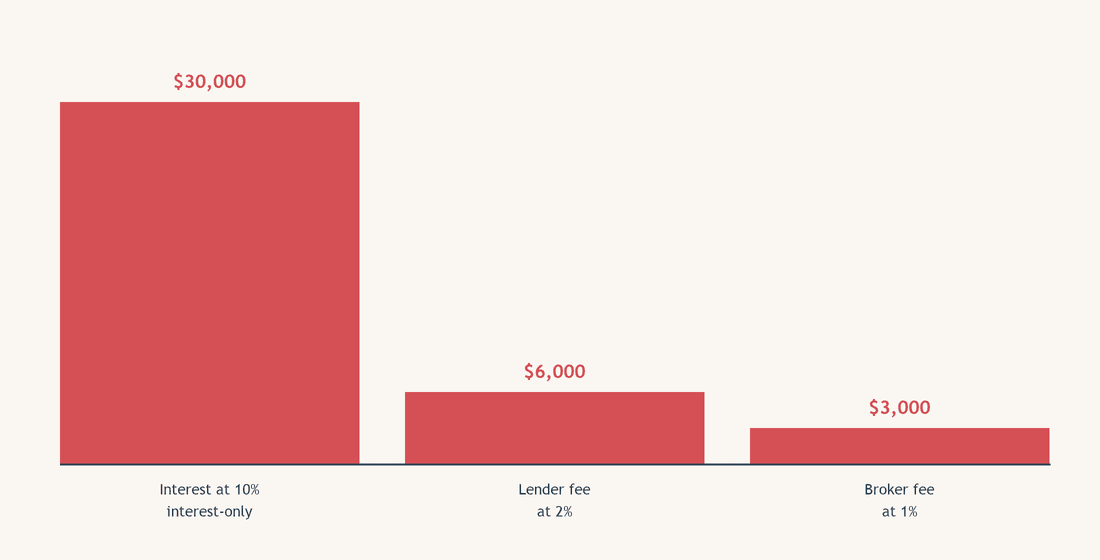
| Illustrative first-year cost of a $300,000 private mortgage | |
|---|---|
| Interest at 10%, interest-only | $30,000 |
| Lender fee at 2%, deducted on funding | $6,000 |
| Broker fee at 1%, deducted on funding | $3,000 |
| Net funds received | about $291,000 before legal costs |
Use the table as a shape, not a quote; the rate and both fees vary with the property and the deal. What it shows is the thing the rate hides: on a $300,000 private mortgage, roughly $9,000 leaves the loan before it reaches you, legal costs on both sides usually fall to the borrower, and a renewal at the end of the year repeats the fees. Three renewals is a fourth set of fees on money you have already borrowed.
Ask for the net funds figure in writing. It is the only number that describes the deal.
Because it is priced to be. A private mortgage runs one year, occasionally two, interest-only, at a cost that no household budget can carry indefinitely, and it exists to buy the time between a bank's no and a bank's yes.
The exit is planned before you sign. Refinancing to a B lender once twelve months of clean payments are on your record; refinancing to a bank once the income is filed; selling; completing the work and reappraising. The subprime mortgages page is the usual next step, and the mortgage refinancing page covers the mechanics of moving.
Borrowers who plan the exit generally do well. Borrowers who plan only the funding renew, and renew again, and the fees compound the way the interest does not.
The property. Address, value, and what is already registered against it. A private lender's whole decision is loan-to-value: most lend to 75% or 80% of appraised value on a first mortgage, less on a second, less again on a rural or unusual property.
An appraisal, ordered by the lender, at your cost.
The exit, in writing. A lender that asks how you will repay is a lender worth dealing with; one that does not ask is counting on the renewal.
Not your income, mostly. Private lenders confirm you can carry the interest and little more. Not your credit, mostly: they look, and it moves the rate a little, but equity decides.
Time. Three of the seven lenders listed fund within two days on their own products; a private placement runs one to two weeks, most of it the appraisal and the lawyers.
Three, and they are the same three that make the product work.
The home is the security, and a private lender enforces faster than a bank. A missed payment on a one-year interest-only mortgage is a default with months, not years, to resolve.
The renewal is not guaranteed. A private lender can decline to renew, and a borrower with no exit and no renewal is selling under pressure.
The fees are front-loaded. Money deducted on funding is gone whether the mortgage runs twelve months or three.
None of that is a reason to avoid the product for the situations above. It is the reason to have the exit before the funding.
Every other tier of mortgage lending is on the mortgage lenders page, and borrowing against equity without replacing your mortgage is on the home equity loans page.
Reviewed by Rafael Rositsan, Co-Founder and CEO, Smarter Loans. Last reviewed 16 September 2026. Lender figures are the lenders' published terms as checked August 2026; the cost example is illustrative.
Well above bank and B-lender rates, set on the property's loan-to-value and marketability rather than your credit, usually interest-only for one year. The rate is not the cost: a lender fee and a broker fee are deducted on funding, and legal costs fall to the borrower. Ask for the net funds figure, the amount that reaches you after everything.
Three of the seven: Canadalend, Clover Mortgage and Homewise, each of which publishes private lending on its own site. They place your mortgage with private lenders and negotiate the terms; the other four listed are A- and B-tier lenders shown because they appear on every mortgage page in the network.
Usually one year, sometimes two, interest-only. It is a bridge to a defined exit: a B-lender refinance once payments are on your record, a bank refinance once income is provable, a sale, or a completed renovation. Renewing repeats the fees.
They look, and it moves the rate a little, but equity decides. Most lend to 75% or 80% of appraised value on a first mortgage and less on a second. Income is confirmed only to the extent of carrying the interest.
A purchase a bank's timeline would lose, income that is real but not yet provable, a credit event still recovering, a property that needs work before it qualifies, or a consolidation where the equity exists and the cash flow does not. In every case, with an exit planned before you sign.