One application. 7 lenders.
Apply Now One application routed to where you qualify.
Every Apply button starts the same single application. Your chosen lender is prioritized first.







| Subprime mortgage | Bank mortgage | Home equity loan | |
|---|---|---|---|
| Rate range | 3.45 - 16% APR | 4 - 17.99% APR | |
| Interest charged on | The full amount, amortized | The full amount, amortized | The full amount from day one |
| Repayment | Fixed payments, often shorter terms | Fixed or variable payments over the amortization | Fixed installments, registered against the home |
| Re-borrow without reapplying | No | No | No |
| Best when | Credit or income documentation blocks a bank approval | You qualify on income and credit at a bank or monoline | A large cost and meaningful equity in your home |
| Watch out for | Higher rates and lender fees than prime | Qualification is strictest here | Setup and legal costs; your home secures the debt |
Two very different things, and telling them apart is worth more than any rate comparison.
B lenders are institutional: trust companies, credit unions, monoline lenders and the alternative arms of larger institutions. They verify income, amortise over twenty-five or thirty years like a bank, and price one to three points above a bank, usually with a fee of around one percent. Most people a bank has declined belong here, and "subprime mortgage" in Canada almost always means this.
Private lenders lend on the property for a year at a time at a much higher cost. That is a different product with its own page, private mortgages, and many borrowers pushed toward it qualify at B tier.
Three of the seven lenders listed arrange B-lender mortgages: Clover Mortgage, Canadalend and Homewise, each of which publishes bad-credit or alternative mortgage lending on its own site. The other four are shown because they render on every mortgage page in the network; nesto, at the 3.45% floor, is an A-tier lender. Our application reaches all seven and routes on how you earn and what your credit looks like.
Four things, and income shape is the most common by far.
Income shape, not income size. Self-employed, commission, contract, rental, or a job that changed recently. A bank wants two years of tax slips; a B lender reads twelve months of bank statements. A self-employed borrower whose deposits are strong and whose filed income is low, because that is how the accountant filed it, is the B tier's core customer.
Credit below a bank's threshold but not catastrophic. Recent late payments, a consumer proposal or bankruptcy now discharged, a thin credit history. A B lender prices it; a bank declines it.
Debt service slightly over. A bank's ratios are fixed; a B lender's are flexible, especially with a larger down payment.
The property. Rural, mixed-use, unusual, or a small unit. A bank can decline on the property alone; a B lender looks at the whole application.
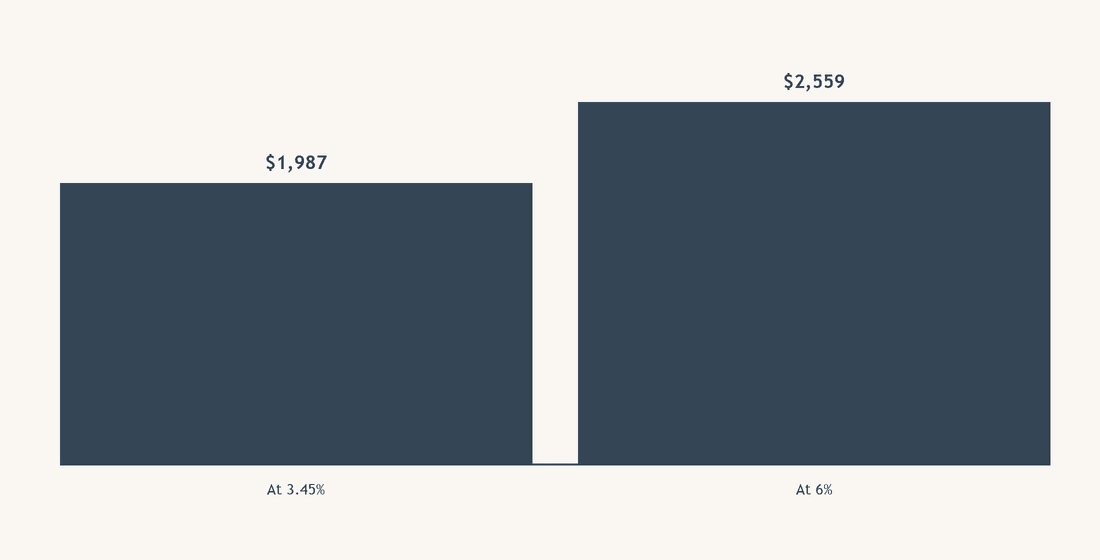
| $400,000 over 25 years | Monthly payment |
|---|---|
| At 3.45%, the lowest published rate among the lenders listed | about $1,987 |
| At 6%, a typical B-tier rate | about $2,559 |
Use the figures to see the gap between the tiers in dollars: about $573 a month on a $400,000 mortgage, or roughly $34,000 across a five-year term, plus a lender fee of around one percent, $4,000, on funding. The mortgage payment calculator runs your own numbers.
That is real money, and the comparison that matters is not B tier against a bank rate you cannot get. It is B tier against renting for another year, or against waiting a year to become bankable. Sometimes waiting wins, and a broker who tells you so is worth more than one who does not.
Expect a larger down payment than a bank asks. Under $500,000 the legal minimum is 5%, and the Financial Consumer Agency of Canada sets out the tiers above that; most B lenders want 20% or more, which also avoids mortgage default insurance.
Most B mortgages run two or three years, and the purpose of the term is to become bankable by the end of it. Four things do that.
Do all four and the renewal is a bank refinance at A-tier rates; the mortgage refinancing page covers moving lenders at term end without a penalty.
Twelve months of bank statements, personal and business if self-employed. This is the application at B tier.
A down payment of 20% or more, or equity of that size on a refinance.
The property, with an appraisal the lender will order.
Credit, considered by all seven lenders listed, decisive with none; it sets the rate within the tier.
A reason. B lenders want to know why the bank said no and what changes by the end of the term. An application with an answer is priced better than one without.
Every lender listed considers poor credit and publishes a $1,500 monthly income minimum, which is a low bar deliberately: at B tier, how you prove income matters more than the number.
Mostly, under a different search name. A bad-credit mortgage, an alternative mortgage, a non-prime mortgage and a B-lender mortgage are the same product in Canada: institutional lending with flexible rules at a higher rate and a fee. The distinction that matters is B against private, not among the names for B.
If the credit is bad enough that no B lender will take you, the honest answer is a year of repair first, or a private mortgage with a B-lender exit planned. The two lenders listed that serve every province, 8Twelve and nesto, are A-tier on their own products; of the three that arrange B lending, Clover and Canadalend serve Ontario and Homewise serves every province except Quebec, so outside Ontario the application routes to Homewise.
Every tier is on the mortgage lenders page, and borrowing against a home without replacing the mortgage is on the home equity loans page.
Reviewed by Vlad Sherbatov, Co-Founder and President, Smarter Loans. Last reviewed 16 September 2026. Lender figures are the lenders' published terms as checked August 2026.
Almost always a B-lender mortgage: institutional lending from trust companies, credit unions or monoline lenders with flexible rules on income and credit, at a rate one to three points above a bank's and usually with a fee of around one percent. It is not the same as a private mortgage, which lends on the property for a year at a much higher cost.
No. B lenders verify income, amortise normally over twenty-five or thirty years and price moderately above a bank. Private lenders lend on equity for a year at a time, interest-only, at the highest cost in mortgage lending. Many borrowers pushed toward private lending qualify at B.
Three of the seven: Clover Mortgage, Canadalend and Homewise, each publishing bad-credit or alternative mortgage lending on its own site. The other four listed are shown because they appear on every mortgage page in the network.
Usually one term, two to three years, with clean payments throughout, revolving balances brought down, income documented the way a bank accepts, and no new credit in the six months before renewal. Done right, the renewal is a bank refinance at A-tier rates.
Usually, around one percent of the mortgage, separate from the rate; $4,000 on a $400,000 mortgage. Ask for the total cost of the deal, rate and fee together, and compare it against renting or waiting a year rather than against a bank rate you cannot get.