One application. 7 lenders.
Apply Now One application routed to where you qualify.
Every Apply button starts the same single application. Your chosen lender is prioritized first.







There are three, and they are different products with different costs, so the first decision is which one you are actually asking for.
A second mortgage. A fixed lump sum registered behind your existing mortgage, repaid over a set term, usually one to five years with the lenders listed. Suits a known one-time amount: a renovation with a quote, a consolidation with a total, a tax bill. Your first mortgage is untouched, which matters if it carries a rate you want to keep or a penalty you want to avoid.
A home equity line of credit. A limit you draw against as needed, interest only on what is out, usually at a variable rate. Suits an ongoing or unpredictable need. Federally regulated lenders cap a standalone HELOC at 65% of your home's value.
A refinance. Replacing your existing mortgage with a larger one and taking the difference in cash. Usually the lowest rate of the three, because it is a first mortgage, but it triggers the penalty on the mortgage it replaces and resets your amortisation. Our mortgage refinancing page works through when the penalty is worth paying.
Most of the seven lenders listed write the first two. The application below asks what the money is for and how long you need it, and routes on the answer; the secured loans and collateral loans pages cover borrowing against other assets, and home renovation loans covers the most common reason for borrowing against this one.
Less than you own, and the lender's number decides, not yours.
The rule most lenders apply is 80% of the home's appraised value across every mortgage combined. On a $600,000 home with $300,000 owing, that is $480,000 of total borrowing allowed, so $180,000 of accessible equity, not the $300,000 you own. A HELOC on its own is capped at 65% with federally regulated lenders. The Financial Consumer Agency of Canada explains how the limits work.
Two things move that number in practice. The appraisal is the lender's, ordered by the lender, and it is usually lower than an owner's estimate of what the house is worth; budget for that before you decide on an amount. And equity-driven lenders, which is most of the seven listed, will sometimes go higher than 80% for a strong property at a higher rate, because the property rather than your income is what they are lending against.
Rates with the lenders listed start between 4% and 6% and the highest published rate is 16%. That is a wider range than any other secured product, and the spread is explained by one thing: whether the lender is pricing your income or your equity.
Income-qualified lending is the bottom of the range. Two lenders publish floors at or below 4.09%, and both want to see income and credit that would qualify for a bank product. If you can qualify that way, do; it is the cheapest borrowing available against a home.
Equity-qualified lending sits higher, into the teens. The lender is pricing the risk that it will have to sell the property, so the rate follows the loan-to-value and the property's marketability rather than your score. This is what makes home equity borrowing available to people a bank has declined, and it is also why the rate can be double the bank's.
A worked example on $50,000 over five years: at 6%, about $967 a month and $7,998 in interest across the term; at 12%, about $1,112 a month and $16,733. The rate matters more on a home equity loan than on smaller borrowing because the amounts are large and the terms long, which is why the section on qualifying on income before equity is worth reading.
Yes, and this is the product where it is most often true. All seven lenders listed consider poor credit, and one sets no minimum at all, because the security is the house.
What changes is the rate and the amount. A lender qualifying on equity rather than credit prices toward the top of its range, and it will lend a smaller share of the value: 65% or 70% rather than 80%. It will also look harder at the property, because the property is the exit if the loan fails.
What does not change is the consequence. A home equity loan in default ends in the lender selling your home, whichever lender it is, and that is the part of bad-credit equity borrowing that deserves the most thought. If the reason for the loan is consolidating unsecured debt, our debt consolidation page covers when moving unsecured balances onto your home makes sense and when it converts a manageable problem into a dangerous one.
The property. A recent appraisal, or the lender will order one. Title, showing what is registered against the home. A current statement for any existing mortgage, showing the balance and the rate.
Income. Every lender listed sets a minimum of $1,500 a month, which is a low bar deliberately: the property carries most of the weight. Income-qualified lenders at the bottom of the rate range will want more, and will want to see it on tax returns rather than statements.
Credit. Considered by all seven, decisive with none. It sets whether you are priced on income or on equity.
Time. Six of the seven lenders publish funding in about a week, because an appraisal, a title search and a legal registration all have to happen; one pays out within two days. Nothing on this list is a same-day product, and any lender that claims otherwise against a home is one to read carefully.
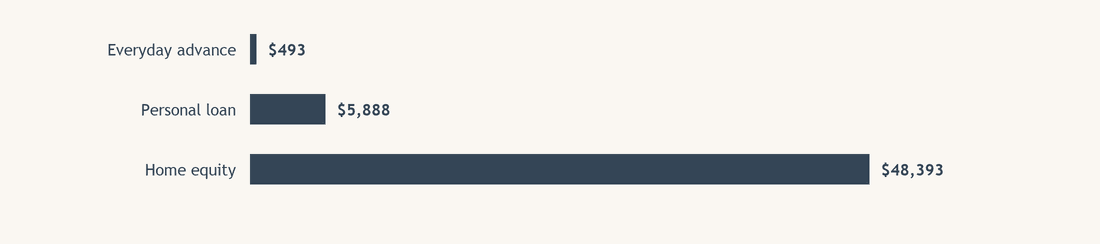
| Product | Average request on our platform |
|---|---|
| Everyday advance, under $1,500 | $493 |
| Personal loan, $1,500 to $35,000 | $5,888 |
| Home equity | $48,393 |
Use the figures below to check your amount against what other homeowners ask for, then set it to the purpose rather than to what the equity would allow. Home equity requests on our platform in the first half of 2026 averaged $48,393 across 148 applications, about eight times the average personal loan and six times the average consolidation request. That is the product doing what it should: a large amount, secured, over a term that makes the payment workable.
The number to be careful with is the ceiling. Seven lenders publish maximums from $1 million to $100 million; almost nobody needs that, and the equity a lender will actually release is bounded by the 80% rule above. A request sized to the renovation quote or the debt total is the one that gets approved at the better end of the range.
Source for all platform figures: Smarter Loans home equity and personal loan applications, January 2026 to June 2026, status Applied.
The honest version, because it is the reason this product is cheaper than an unsecured loan.
A home equity loan is registered against your home. If you stop paying, the lender can enforce that registration: in most provinces a power of sale or foreclosure, after notice, with the lender selling the property and taking what it is owed from the proceeds. A second mortgage lender sits behind your first mortgage in that process but has the same right to start it.
That is not a reason to avoid the product. It is a reason to borrow for things that are worth the house: a renovation that adds value, a consolidation that ends a cycle, a business that has a plan. It is not the product for a vacation or for covering a shortfall that will recur, and the personal loans page exists for the amounts and purposes where an unsecured loan is the safer answer. If you are over 55 and the aim is income rather than a lump sum, a reverse mortgage is a different product with no payments during your lifetime.
Our guide to HELOC strategies covers using a line rather than a loan, and the mortgages page covers the refinance route in full.
Reviewed by Rafael Rositsan, Co-Founder and CEO, Smarter Loans. Last reviewed 15 September 2026. Platform figures cover applications from 1 January to 30 June 2026.
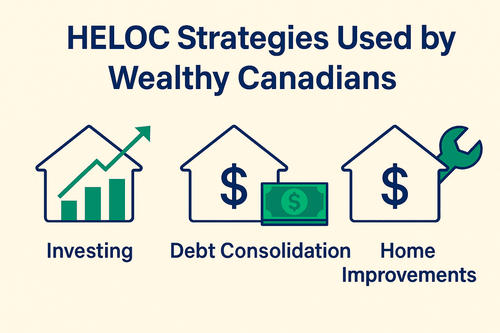
HELOC Strategies Canadians Use, and What They Risk
How Canadians borrow against home equity to invest, consolidate or hold liquidity, what each approach costs, and where the risk sits.
Budget Renovations With the Highest Return in Canada
Which affordable renovations actually add resale value in Canada, what they cost, and how to fund one without overborrowing.

Mortgages vs Home Equity Loans in Canada: Which Is Right for You?
Most lenders allow borrowing up to 80% of the home's appraised value across all mortgages combined; a standalone HELOC is capped at 65% with federally regulated lenders. On a $600,000 home with $300,000 owing, that leaves about $180,000 accessible. The lender orders the appraisal, and it is usually lower than the owner's estimate.
Yes. All seven lenders listed consider poor credit, and one sets no minimum, because the home is the security. Expect a higher rate, into the teens, and a lower loan-to-value than an income-qualified borrower would get. The consequence of default is the same at any rate: the lender can sell the home.
A home equity loan is a fixed lump sum on a set term, usually as a second mortgage; a HELOC is a limit you draw against as needed with interest only on what is out, usually at a variable rate. The loan suits a known one-time amount; the line suits an ongoing need. The line is capped at 65% of value on its own; the loan at 80% combined.
About a week with six of the seven lenders listed, because an appraisal, a title search and a legal registration all have to happen. One lender pays out within two days. No home equity product is same-day, and one that claims to be deserves a careful read.
On our platform in the first half of 2026, home equity requests averaged $48,393, about eight times the average personal loan of $5,888. The amount a lender releases is bounded by the 80% combined rule, not by the published maximums, which run to $100 million and are rarely relevant.