One application. 11 lenders.
Apply Now One application routed to where you qualify.
Every Apply button starts the same single application. Your chosen lender is prioritized first.











Use the figures below to see what other people borrow for a wedding before you decide on a number. The averages are higher than most other purposes, and the section after this shows how following the deposit schedule can bring yours down.
Every other purpose on this site produces something that lasts or saves money: a repaired car, a consolidated balance, a procedure, a business. A wedding produces a day. That is not an argument against borrowing for one; it is the reason the amount deserves more scrutiny here than on any other page, because there is no asset to sell and no saving to offset the interest if the number was wrong.
On Smarter Loans, from January 2026 to June 2026, weddings and events were the stated purpose on 1.3% of personal loan applications, averaging $6,932 against $5,888 across all purposes.
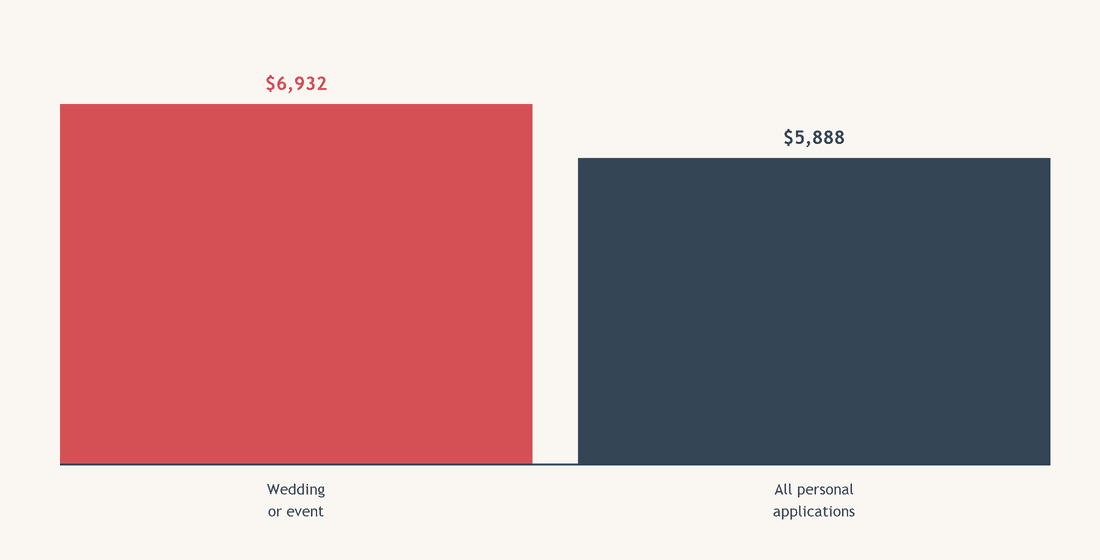
| Purpose | Average personal request |
|---|---|
| Wedding or event | $6,932 |
| All personal applications | $5,888 |
Source: Smarter Loans platform data, personal loan applications of $1,500 to $35,000, January 2026 to June 2026, 178 wedding or event applications.
We do not separate weddings from other events in the data, and we do not see the total budget behind the request, so the figure is what people borrow toward a wedding rather than what a wedding costs.
The arithmetic is the same as any installment loan, and it reads differently when the thing bought is over before the second payment.
$10,000 over 36 months at 19.99% APR is about $372 a month and about $3,374 in interest. The interest alone is a third of the wedding. Over 24 months it is about $509 a month and about $2,216 in interest; over 60 months, about $265 a month and about $5,900. The personal loan calculator prices any amount over any term, and the number to read is the total interest, because it is the price of the day beyond the day.
The term is the lever, as on every page here, with one difference. A repair loan's term is bounded by the repair's useful life; a wedding loan's is bounded only by what the month can carry, and the temptation is to stretch it until the payment disappears into the budget. Five years of payments for one day is the outcome that rule exists to prevent.
The most useful thing is not a lender. It is the observation that a wedding is paid in stages, and a loan does not have to cover all of them.
Venues, caterers and photographers take deposits months ahead and balances near the date. That schedule is a payment plan, and it means the borrowing question is not "how much is the wedding" but "which payments fall before the money is there." A couple saving $800 a month toward a date fourteen months out has $11,200 by the day; the loan, if any, covers the deposits due before the savings catch up, and it can be small.
The rule: list every payment by due date, subtract what will be saved by each date, and borrow only the gaps. A line of credit fits that shape better than a loan, because you draw for each deposit and repay as savings arrive, paying interest only on what is out. The Financial Consumer Agency of Canada's budgeting guidance covers the saving side.
Eleven lenders offer personal loans from $100 to $35,000 unsecured, from 8.99% APR up to the 35% federal cap on installment loans, on terms to 84 months. Minimum income runs from $1,000 to $2,500 a month from any regular source, most commonly $1,500. Six of the eleven will consider a poor score.
A wedding purpose is neither a plus nor a minus to these lenders; they read regular deposits first, existing commitments second, the score last. What a wedding application often carries that others do not is a second applicant. A joint application on two incomes looks strong where both are regular, and it is worth knowing before applying that a joint loan is a joint obligation: each of you owes all of it.
On our platform in the first half of 2026, 46.3% of personal applicants carried a fair score, 23.6% poor and 22.1% no usable score. Six of the eleven lenders consider a poor score, so availability is rarely the problem. The rate is. A poor-score file prices near the 35% cap, and at that rate $10,000 over 36 months costs about $6,280 in interest, which is most of a second wedding.
That is the strongest case on this site for borrowing less rather than borrowing anyway: a smaller wedding, a longer engagement, or a loan sized to the deposit gaps rather than the total. The bad credit loans page covers how these lenders assess your application; our guide to going from bad credit to over 700 covers what a year of clean payments does to the rate on the next loan.
For a couple who can clear the balance inside a promotional window, a card at 0% for a year beats every loan, and the deposit schedule above makes that window easier to hit than people assume, since the largest payments fall last. For a couple who would carry the balance past the window, the card's standard rate is usually above a personal loan's, and a card has no payoff date, which is the trap. Five years of minimum payments on a wedding is a card outcome far more often than a loan one.
The honest combination is a card for the payments that will clear inside the window and a small loan or line for the deposits that will not, with the loan's term ending inside a year. What to avoid is the reverse: a loan for the total and a card for the extras, which is two balances and no plan. And whichever route is taken, the payoff date should be written down before the invitations are, because it is the one date on the calendar nobody else will remind you of.
If the gaps are small and recurring, a line of credit fits better than a loan; if the total is a single known sum, the installment loans page covers the product. All personal loan options are on the personal loans hub.
Source for all platform figures: Smarter Loans personal loan applications, January 2026 to June 2026.
Reviewed by Vlad Sherbatov, Co-Founder and President, Smarter Loans. Last reviewed 9 September 2026. Platform figures cover applications from 1 January to 30 June 2026.

How Canadians Can Borrow for Wedding Expenses
How wedding financing works in Canada, why it is just an unsecured personal loan, and how it compares to putting the cost on a…

When Should You Use a Personal Loan in Canada?
When a personal loan is the right tool and when it is not: what Canadians borrow for, what it costs against a credit card,…

How to Find the Best Loan Rates in Canada
How to compare personal loan rates in Canada: APR over advertised rate, total cost over monthly payment, and how to shop without damaging your…
Yes. Eleven lenders offer personal loans from $100 to $35,000 unsecured, and eight consider a poor score. On our platform in the first half of 2026, weddings and events were the purpose on 1.3% of personal applications, averaging $6,932. The better question is how much of the wedding to borrow, since it is the one purpose with a date and no return.
$10,000 over 36 months at 19.99% APR is about $372 a month and about $3,374 in interest, a third of the wedding again. Over 60 months the interest is about $5,900. The term is the lever, and the temptation to stretch it until the payment disappears is what turns one day into five years of payments.
Use the deposit schedule. Venues and vendors take deposits months ahead and balances near the date, so list every payment by due date, subtract what will be saved by each date, and borrow only the gaps. A line of credit fits that shape better than a loan, since you draw for each deposit and repay as savings arrive.
Six of the eleven lenders will consider a poor score, and all read deposits before the score. The rate is the issue: near the 35% cap, $10,000 over 36 months costs about $6,280 in interest. A smaller wedding, a longer engagement, or a loan sized to the deposit gaps is the honest answer at that rate.
A joint application on two regular incomes looks strong and can support a larger amount or a better rate. It is also a joint obligation: each of you owes all of it, whatever happens afterwards. Apply jointly only if both of you would be comfortable carrying the full payment alone.