One application. 7 lenders.
Apply Now One application routed to where you qualify.
Every Apply button starts the same single application. Your chosen lender is prioritized first.







Whether you own the land under a mobile or modular home changes the product entirely, and it affects the cost far more than the home itself does.
| Home on land you own | Financed as real property. Mortgage terms, longer amortizations, more lenders. |
| Home on leased land in a park | Financed as chattel, closer to a vehicle loan. Shorter terms, higher rates, fewer lenders. |
| RV or motorhome | Terms commonly up to 180 months on larger units, because they hold value over a longer horizon than a car. |
| Park model home | Narrowest lender pool of the four. Often chattel regardless of the land arrangement. |
The land decides, not the home. Two identical manufactured homes finance completely differently depending on what is underneath them, and establishing which one you are buying comes before any lender.
On land you own, permanently affixed to an approved foundation: the home is real property. It is financed as a mortgage, at mortgage rates and over mortgage amortisations, and the seven mortgage lenders listed take it as one. Mortgage default insurance may be available, which brings the down payment to the same 5% minimum as a house under $500,000.
On leased land in a park, or movable: the home is chattel, personal property. It is financed as a chattel loan, secured under provincial personal property law rather than on title, at higher rates over shorter terms. No lender in the Smarter Loans network currently publishes a chattel loan for a manufactured home; a bank, a credit union, or the park's own financing arrangement is where that loan is found, and an unsecured personal loan covers the smallest purchases.
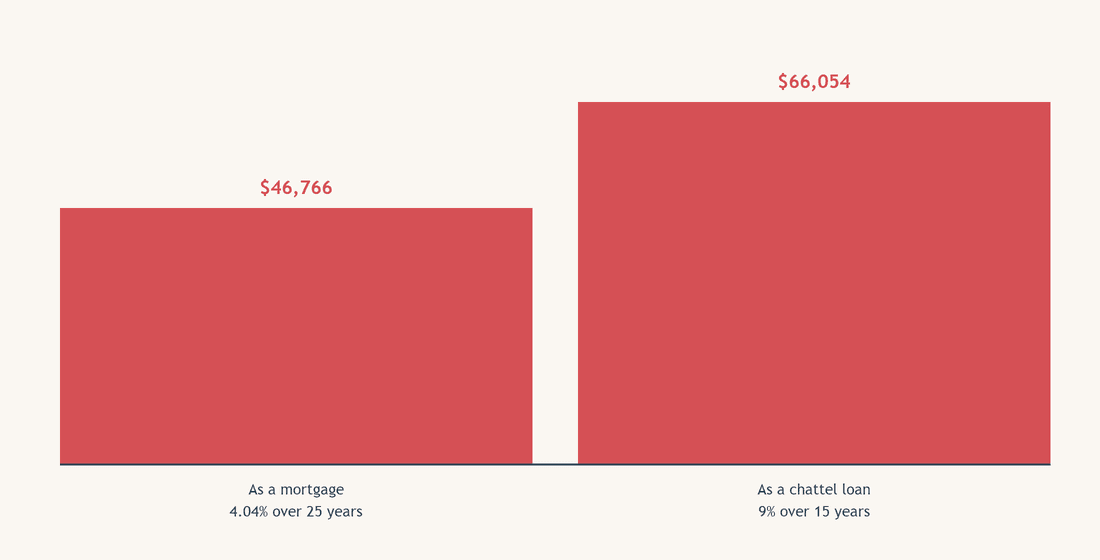
| $80,000 manufactured home | Monthly payment | Total interest |
|---|---|---|
| As a mortgage at 4.04% over 25 years | about $423 | about $46,766 |
| As a chattel loan at 9% over 15 years | about $811 | about $66,054 |
Use the table to see what the land is worth to the financing. The chattel rate is illustrative, but the shape is not: the same home on leased land costs roughly double the monthly payment and $19,000 more in interest over a shorter term. Land you own is the single largest thing you can do for the cost of a manufactured home.
A CSA label. Homes built to CSA Z240 MH for mobile homes, or A277 for factory-built homes, carry a certification label physically attached to the unit. Financing a home without one is difficult with any lender, mortgage or chattel.
Age. Many lenders set a maximum age, and older units that finance at all carry shorter terms. On a mortgage, the lender is asking whether the home will outlast the amortisation.
The foundation. Permanently affixed on an approved foundation supports mortgage treatment; blocked and tied down usually does not. The foundation is what turns the home into real property.
The park lease, where there is one. A lender will not finance beyond your right to occupy the land. A lease with eight years left supports an eight-year loan at most, and this is the condition that surprises most buyers on leased land.
Park rules. Restrictions on the age of homes, on resale and on subletting affect both value and marketability, and a lender reads them.
On owned land, yes: every one of the seven mortgage lenders listed considers poor credit, because the property is the security, and the subprime mortgages page covers what a B lender wants to see. Expect a larger down payment and a rate above the 4.04% floor.
On leased land it is harder, because a chattel lender's security is a home it cannot easily resell, and poor credit stacks a second risk on the first. A larger down payment is what moves a chattel application, and where the amount is small enough the bad credit loans page covers unsecured lending that puts nothing at risk.
As vehicles, not homes, even when lived in full time. An RV is a chattel purchase at vehicle rates and terms: longer than a car, shorter than a mortgage, with the steep early depreciation that creates negative equity on a long term.
One lender in the Smarter Loans network finances RVs and trailers: Spring Powersports, from $3,000 to $75,000 at 8.99% to 34.95% over one to fifteen years, new, used or from a private seller, in every province and territory, with income of at least $2,000 a month and a credit score of 550 or better. The term should be shorter than the longest offered; the powersports financing page covers why, and the boat loans page covers the survey and lien steps that apply to a private RV sale as well.
Full-time living in an RV is worth telling the lender rather than concealing. It affects wear, insurance and the resale assumption, and a lender that finds out later is a worse outcome than one that prices it upfront.
On a leased lot, the lot rent: monthly, rising, and payable whatever happens to the financing. Over a long term the rent often exceeds the loan payment, and it is the number a lender on leased land weighs against your income.
On owned land, property tax, utilities and the maintenance of a home that was built to be moved: skirting, roof seals, plumbing that runs outside the envelope.
On an RV, storage, insurance, and the maintenance profile of a vehicle that is also a building. Roof seals, slides, plumbing and appliances fail on a schedule.
The seven mortgage lenders listed take a manufactured home on owned land as a mortgage, on the same basis as any house: appraisal, title, income documented to the tier, poor credit considered by all seven. None of the seven publishes a product specific to manufactured homes, and none finances a home on leased land; the cards show mortgage terms, and they apply where the home is real property. For an RV, the lender is Spring Powersports, above. Our application reaches all of them and routes on what the home sits on.
Every tier of mortgage lending is on the mortgage lenders page.
Reviewed by Vlad Sherbatov, Co-Founder and President, Smarter Loans. Last reviewed 16 September 2026. Lender figures are the lenders' published terms as checked August 2026; the chattel example is illustrative.
Only if it sits on land you own and is permanently affixed to an approved foundation. Then it is real property, and the seven mortgage lenders listed take it as a mortgage from 4.04%. On leased land it is chattel, financed at higher rates over shorter terms, and no lender in the network currently publishes that product.
On owned land, yes: every lender listed considers poor credit, because the property is the security, with a larger down payment and a higher rate. On leased land it is harder, because the lender's security is a home it cannot easily resell, and a larger down payment is what moves the application.
The Canadian standard for mobile homes; A277 is the equivalent for factory-built homes. The certification label is physically attached to the unit, and financing a home without one is difficult with any lender.
Yes. A lender will not finance beyond your right to occupy the land, so a short remaining lease shortens the loan. Park rules on the age of homes, resale and subletting also affect the value a lender will recognise.
As a vehicle. One lender in the Smarter Loans network, Spring Powersports, finances RVs and trailers from $3,000 to $75,000 at 8.99% to 34.95% over one to fifteen years, including private sales, in every province and territory. Keep the term shorter than the longest offered, because the RV loses value faster than the balance falls.