One application. 5 lenders.
Apply Now One application routed to where you qualify.
Every Apply button starts the same single application. Your chosen lender is prioritized first.



The 35% federal rate cap applies everywhere in Canada, but provinces differ on licensing and lender obligations.
| Province | Rate cap | High-cost credit licensing | Regulator |
|---|---|---|---|
| Alberta | 35% APR | HCC licence for products >=32% APR | Service Alberta, Consumer Protection Act Payday Loans Regulation |
| British Columbia | 35% APR | HCC licence for products >=32% APR | Consumer Protection BC, BPCPA Part 6.1 |
| Manitoba | 35% APR | HCC grantor licences exist | Consumer Protection Office, Manitoba |
| New Brunswick | 35% APR | No separate provincial high-cost credit licensing band; federal 35% APR cap governs | Financial and Consumer Services Commission |
| Newfoundland and Labrador | 35% APR | NL HCC regime recent | Digital Government and Service NL |
| Nova Scotia | 35% APR | None | Service Nova Scotia |
| Ontario | 35% APR | None | Consumer Protection Ontario |
| Prince Edward Island | 35% APR | None | Consumer Services PEI |
| Quebec | 35% APR | Quebec applies extra rules above a threshold rate, including a check that you can afford the payments. | Office de la protection du consommateur |
| Saskatchewan | 35% APR | None | Financial and Consumer Affairs Authority |
| Northwest Territories | 35% APR | None | NWT Consumer Affairs |
| Nunavut | 35% APR | None | Nunavut Consumer Affairs |
| Yukon | 35% APR | None | Yukon Consumer Services |
Three places sell the same product, and they are priced differently because they are paid differently.
The dealer arranges financing through lenders it works with and is paid a share of the rate. It is convenient, it is where most Canadian car loans are signed, and it is the place where a rate and a price get negotiated together, which is how a low payment can hide a high price or a long term. Walk in with your own approval and the dealer's finance office becomes a comparison rather than the only option.
A bank or credit union lends at the lowest rates to borrowers with good credit and a relationship, takes days to decide, and declines most people with a poor or thin credit history.
A direct lender, which is what the five lenders listed are, decides on your bank statements and the car, approves within two days, and lends to people the bank declined. It charges more for that: rates start at 6.93% and run to 35%. The car is the security, which is why four of the five consider poor credit.
The right order is the bank if you qualify, then a direct lender's approval in hand before you visit a dealer, so the dealer has a number to beat. The application below reaches all five direct lenders at once.
Rates with the lenders listed start between 6.93% and 8.99% and run to 35%, the federal cap. Where you land is set by three things.
Your credit. More than on any other secured product except a mortgage, because cars depreciate fast and the lender's security shrinks every month. A good score gets the floor; a poor one gets the top of the range or a lender that reads bank statements instead.
The car. Newer, lower mileage, mainstream make and model: lower rate and longer term. Older, high mileage, specialised: higher rate, shorter term, and a floor on the vehicle's age or mileage that some lenders will not go past.
The term and the down payment. A longer term lowers the payment and raises the total; a down payment lowers both. A worked example on $25,000: over 72 months at 7.99% it is about $438 a month and $6,551 in interest; over 48 months at the same rate, $610 a month and $4,290. At 18%, which is where a poor score often lands, 72 months costs about $570 a month and $16,054 in interest, more than half the price of the car again.
That last number is the one to sit with. The payment looks affordable; the total is not. A shorter term or a larger down payment is worth more than a slightly lower rate.
Yes, and more readily than a personal loan for the same amount, because the car is the security. Four of the five lenders listed consider poor credit; one wants a fair score.
What changes: the rate, toward the top of the range; the term, which the lender may cap; and the down payment, which the lender may require. What helps: a down payment of ten percent or more, a newer car, and three months of bank statements showing regular income, because direct lenders read those before the score. Our bad credit car loans page covers what to expect in detail, and what a car loan repaid on time does for your score afterwards.
Income. Every lender listed publishes a minimum: $1,500 a month for two of them, $1,800, $2,000 and $2,500 for the others. Regular deposits into a bank account are what they read; a pay stub helps but is not what decides it.
The car. Year, make, model, mileage, and the price or the bill of sale. Lenders finance a specific vehicle, and they check its value against the loan. A car worth less than the loan is the most common reason a good applicant is declined.
A licence and insurance. A valid driver's licence and proof you can insure the vehicle. A lender will not fund a car that cannot legally leave the lot.
Down payment. Not always required, but it moves the rate, the term and the approval. Ten percent is the common ask on a poor-credit file.
Speed. Every one of the five lenders listed pays out within two days of approval, and most decisions come back the same day. The car loan is the one product where a direct lender is reliably faster than a bank.
Yes. Private sales are usually cheaper than dealer prices, and the lenders listed will finance one with three extra steps: a lien search on the VIN, so you are not buying a car that already secures someone else's loan; a mechanical inspection, because no dealer stands behind the condition; and payment direct to the seller by the lender. Our private sale car loans page walks through the sequence.
If your credit has improved since you signed, or the dealer's rate was high, refinancing can cut the rate and the total. One lender listed offers it, on a 96-month term, and it works only where the car is worth more than what you owe; negative equity, which is common on long dealer loans, is what stops most refinances. The auto refinancing page and its calculator show whether yours clears that bar. If the car needs work rather than a new loan, the car repair loans page covers borrowing for the repair; if you own the car outright and need cash against it, car title loans is a different product with different risks.
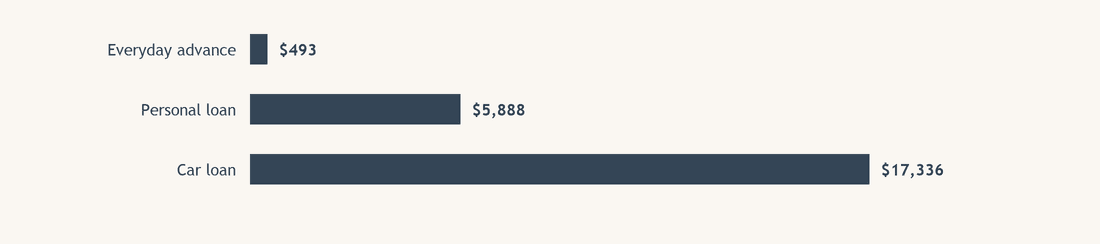
| Product | Average request on our platform |
|---|---|
| Everyday advance, under $1,500 | $493 |
| Personal loan, $1,500 to $35,000 | $5,888 |
| Car loan | $17,336 |
Use the figures below to check your request against what other buyers ask for, then set it to the car and your down payment rather than to the most a lender will offer. Car loan requests on our platform in the first half of 2026 averaged $17,336 across 193 applications, about three times the average personal loan. That is a used-car number, not a new-car one, and it is the honest centre of this market: most people financing a car through a direct lender are buying a three-to-six-year-old vehicle for less than $25,000.
The lenders listed publish maximums up to $200,000. A request sized to the car you are actually buying is the one that gets approved at the better end of the range; a request that maxes the limit is priced as the risk it is.
Source for all platform figures: Smarter Loans auto and personal loan applications, January 2026 to June 2026, status Applied.
The Financial Consumer Agency of Canada covers what to check before signing a car loan, and every other personal product is on the personal loans page.
Reviewed by Vlad Sherbatov, Co-Founder and President, Smarter Loans. Last reviewed 15 September 2026. Platform figures cover applications from 1 January to 30 June 2026.

How to Judge a Loan Company in Canada
What separates a reliable loan company from a risky one in Canada: licensing, real APRs, fees in writing, and what borrowers like you get…
How Loan Interest Rates Are Set in Canada
What decides your personal loan rate in Canada, from the Bank of Canada rate to your credit band, and the moves that actually lower…

Secured Loans in Canada: How They Work
What a secured loan is, what you can pledge, how much cheaper it is than unsecured borrowing, and what happens if you cannot repay.
There is no fixed score. Four of the five lenders listed consider poor credit and one wants a fair score, because the car is the security; what they read first is three months of bank deposits and the value of the car against the loan. Credit sets the rate, from 6.93% at the floor to 35% at the cap, more than it sets the approval.
More than the payment suggests. $25,000 over 72 months at 7.99% is about $438 a month and $6,551 in interest; the same loan at 18%, where a poor score often lands, is about $570 a month and $16,054 in interest. A shorter term or a larger down payment cuts the total more than a slightly lower rate does.
Get a direct lender's approval first, then let the dealer try to beat it. Dealers are paid a share of the rate and negotiate the rate and the price together, which is how a low payment hides a high price. A bank is cheaper still if you qualify, but declines most people with a poor or thin credit history.
Yes. Every lender listed will, with a lien search on the VIN, a mechanical inspection and payment direct to the seller. Private sales are usually cheaper than dealer prices, which often more than offsets a slightly higher rate.
On our platform in the first half of 2026, car loan requests averaged $17,336 across 193 applications, about three times the average personal loan. That is a used-car figure: most buyers financing through a direct lender are buying a three-to-six-year-old vehicle for under $25,000.