One application. 1 lender.
Apply Now One application routed to where you qualify.
Every Apply button starts the same single application. Your chosen lender is prioritized first.

Only if it cuts the total you pay, and the payment is not the total.
One lender in the Smarter Loans network refinances car loans, and it refinances onto a 96-month term. That is the number to hold in mind. A lower rate over a longer term can produce a lower payment and a higher total, and the difference is not small.
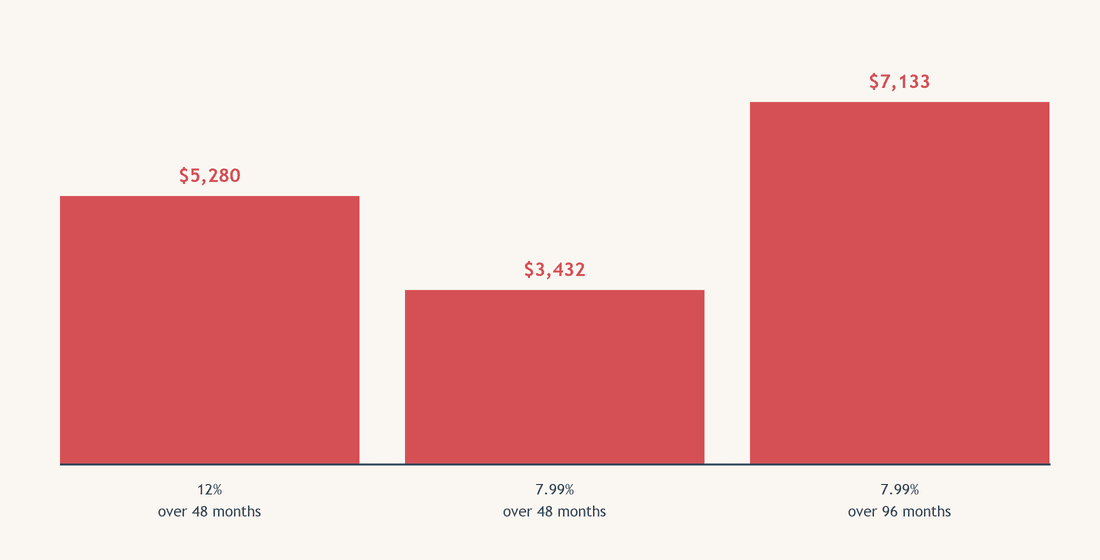
| $20,000 remaining | Monthly payment | Total interest |
|---|---|---|
| 12% over the 48 months you have left | about $527 | about $5,280 |
| Refinanced at 7.99% over 48 months | about $488 | about $3,432 |
| Refinanced at 7.99% over 96 months | about $283 | about $7,133 |
Use the table before you apply. Refinancing the same remaining term at the lower rate saves about $1,850. Refinancing onto 96 months halves the payment and costs about $1,850 more than doing nothing, on a car that will be eight years older when the last payment lands. The auto loan refinancing calculator runs your own balance, rate and term against any offer.
The lender's term is fixed at 96 months, so the way to keep the total down is to keep paying more than the minimum; ask whether prepayment is free before you sign, because the lender publishes nothing on it.
Three situations, and the lender listed requires the first in all of them: the loan is at least a year old.
Your credit has improved. A loan signed at 18% on a thin or bruised file, twelve months of clean payments later, can be refinanced at a rate that reflects the new score. This is the case that saves the most.
The dealer's rate was high. Dealer financing is paid a share of the rate and negotiated alongside the price, which is how a strong buyer ends up at 11%. A direct lender's rate on the same car and borrower can be several points lower.
The payment does not fit any more. Income has fallen and the payment has to come down. Refinancing onto a longer term does that, at a cost in total interest, and it is an honest use of the product when the alternative is missing payments. Know that you are paying for relief, and look at car repair loans or a car title loan only if the need is cash rather than a lower payment.
Negative equity is the most common reason a refinance fails: the lender is being asked to lend more than its security is worth. It is also the normal state of a long dealer loan in its first two years, because the car loses value faster than the balance falls.
The lender listed publishes that it runs programs specifically for vehicles with negative equity, which most refinance lenders do not. Expect the terms to reflect the risk: a rate above the 6.93% floor, and possibly a down payment to close part of the gap. If the gap is large, the honest arithmetic is often to keep paying the existing loan until the car's value catches up, and refinance then.
A loan at least a year old, in your name, on a car you still have. The lender publishes no vehicle age or mileage limit, so an older car is not ruled out.
Income of at least $1,500 a month, from any regular source.
Any credit band. The lender pre-qualifies without a credit check and considers every band. Your score sets the rate, from 6.93% at the floor.
A province it serves. Nine of them: Ontario, British Columbia, Alberta, Manitoba, Saskatchewan, Nova Scotia, New Brunswick, Newfoundland and Labrador, and Prince Edward Island. Not Quebec, not the territories.
The payout figure from your current lender. The refinance pays that off directly; you need the exact number, and you should ask your current lender whether it charges a penalty to close early.
It pays out within two days of approval.
You apply once, the lender pre-qualifies on your bank data without touching your credit, and if the rate works it requests the payout figure from your current lender. The new loan pays the old one off, the old lender discharges its lien, the new lender registers its own, and your payment changes on the next cycle. Two to three weeks end to end is typical, most of it waiting on the old lender.
On our platform, car loan requests average $17,336, which is about where a three-to-six-year-old car sits; a refinance of that size at the rates above is the difference of a few thousand dollars over the term, in either direction, depending on the term you choose.
For a new car loan rather than a refinance, the car loans in Canada page lists five lenders. The Financial Consumer Agency of Canada covers what to check before signing a car loan.
Reviewed by Vlad Sherbatov, Co-Founder and President, Smarter Loans. Last reviewed 16 September 2026. Lender figures are the lender's published terms as checked September 2026. Platform figures cover applications from 1 January to 30 June 2026.
Yes, with one lender in the Smarter Loans network, once your loan is at least a year old. It refinances $7,500 to $200,000 from 6.93% onto a 96-month term, in nine provinces but not Quebec, and considers every credit band. Whether it saves money depends on the total over the new term, not the payment.
The lender listed publishes programs for negative equity, which most refinance lenders do not. Expect a rate above the floor and possibly a down payment to close part of the gap. If the gap is large, keeping the existing loan until the car's value catches up is often cheaper.
Almost always, because the new term is 96 months. $20,000 at 12% with 48 months left costs about $527 a month; refinanced at 7.99% over 96 months it costs about $283. But the second loan pays about $1,850 more in interest than the first. A lower payment and a lower total are different things.
The lender pre-qualifies without a credit check. A full application is a hard inquiry, which costs a few points for a few months; a refinance that then reports clean payments at a lower rate is a net positive within a year.
The lender pays out within two days of approval, but the whole process runs two to three weeks, most of it waiting on your current lender to provide the payout figure and discharge its lien.