One application. 11 lenders.
Get Funded One application routed to where you qualify.
Every Apply button starts the same single application. Your chosen lender is prioritized first.











Three things about the trade change how every lender assesses it, and they are the reason restaurant financing is its own category rather than a business loan with a different name.
Card sales dominate revenue. Deposits arrive daily, they are verifiable to the dollar, and they are hard to overstate. That makes a restaurant a natural fit for loans repaid from your sales that read the merchant statement and remit from card receipts. Most lenders will look at three to six months of card processing statements before anything else.
Margins are thin and fixed costs are high. Rent, labour and food cost leave little room. A lender models repayment against your slowest week, not your average one, because a fixed remittance that fits a July Saturday can sink a January Tuesday.
Failure rates are higher than in most sectors. That is priced in, and it is why time in business is weighted so heavily. Nine of the eleven lenders want six months in business; two accept three.
Owner credit still matters, but less than in almost any other business category. Lenders who lend against your sales underwrite the sales. In the first half of 2026, 49.6% of business applicants on our platform carried no usable personal credit score, and these restaurant lenders are among those most comfortable with that kind of applicant.
That is also why a restaurant with two years of clean card statements and a weak owner score will often get a better offer here than a new opening with a strong one. The statements are your application. A lender reads them before it reads anything about you.
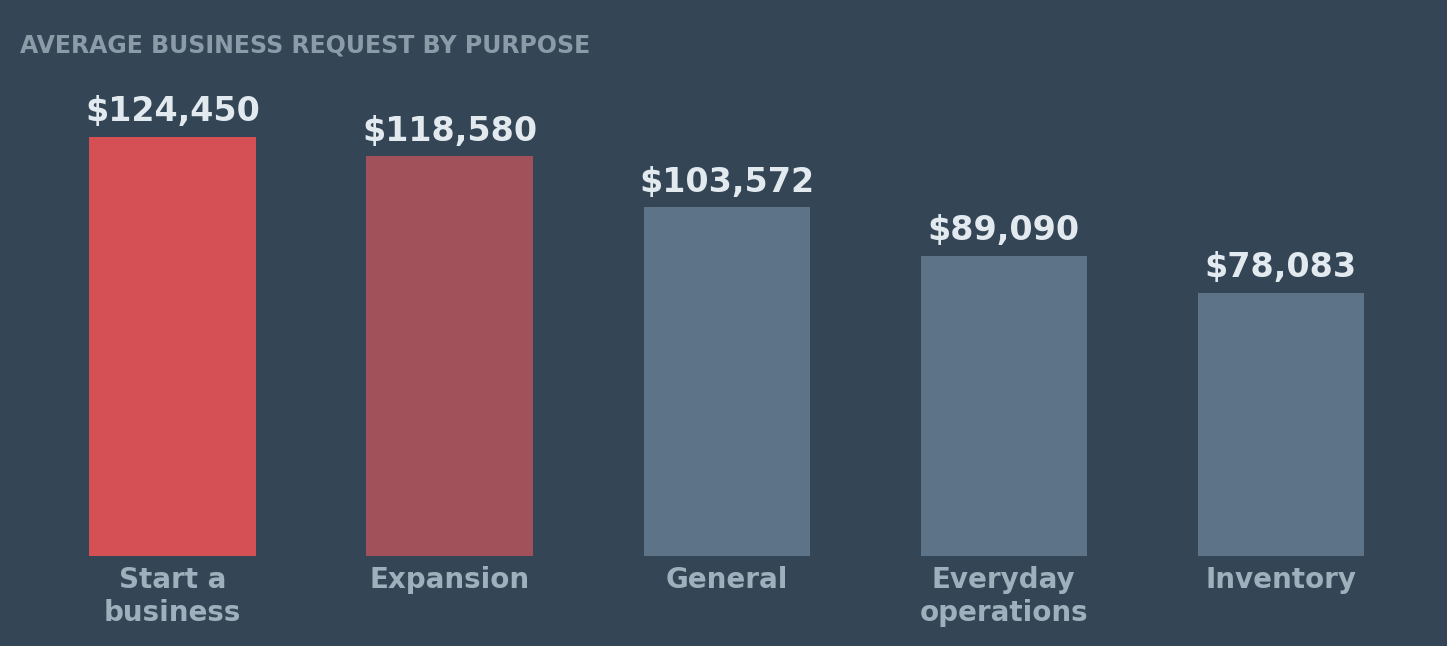
Use the figures below to size your request. Most restaurant borrowing is smaller than the averages, and a request that matches a specific cost, a cooler or a patio or one slow month, is a stronger application than a round number.
| Stated purpose | Average request |
|---|---|
| Start a business | $124,450 |
| Expansion | $118,580 |
| General business | $103,572 |
| Everyday operations | $89,090 |
| Purchase inventory | $78,083 |
Opening and expanding sit above $110,000 across all business applications on our platform in the first half of 2026. Operating capital and inventory sit closer to $80,000. Bear in mind that 68.8% of all business requests were for under $50,000, so a large share of restaurant borrowing is smaller than any of those averages: a walk-in cooler, a patio build, a seasonal stock-up, a slow month.
The eleven lenders write from $2,500 to $2 million. Rates on term loans start between 7.5% and 16%, and three lenders price their advances as factor rates from 1.1. Minimum sales run from $5,000 to $20,000 a month, and six lenders want $10,000. The two lenders that accept three months in business are at opposite ends of that range, one at $5,000 and one at $20,000, so a new opening has a route in at either size.
The most expensive mistake in this sector is using working capital to buy equipment.
A commercial oven, a hood system, a walk-in cooler, an espresso machine: all of these hold value and last for years. Financed against the asset itself, they carry a lower rate and a term matched to their life, five years or more. Bought out of a merchant cash advance repaid in eight months, the same $40,000 hood costs several times more, and the remittance lands during the exact weeks you are still installing it.
The rule: if the money buys something durable, finance it as that thing, through equipment financing. If it covers a gap, use working capital. If it covers a short opportunity against strong card sales, a merchant cash advance can fit, and our page on it works through the arithmetic. The restaurant equipment rental calculator compares buying, financing and renting on the same piece of kit.
A restaurant is one of the few businesses where the lender can see the whole picture in two statements, and it helps to have looked at them first.
Card sales as a share of revenue. Above 70% and loans repaid from your sales fit. Below that, with significant cash or invoice revenue, a term loan reads better.
How steadily money comes in. Daily deposits with a weekly pattern read well. A month with a two-week gap looks like a closure, whatever the reason.
Food cost and labour as a share of sales. Not every lender asks, but the ones that do are the ones offering the better rates. The restaurant profit margin calculator runs the standard ratios.
Remaining lease term. A lender will not finance beyond your right to occupy. Eighteen months left on the lease caps the term of anything you borrow.
The same assessment applies with different weightings. A bar's revenue is more concentrated on fewer nights, so remittance modelling against the slow days matters more. A cafe with a strong morning trade has the most regular pattern of deposits in the sector and often looks stronger than its size suggests. A catering operation with invoice revenue rather than card revenue is a working capital or invoice factoring file, not a revenue-based one. Restaurants Canada tracks sector conditions, including the cost pressures every lender is modelling against: restaurantscanada.org.
Every restaurant has a calendar, and the calendar decides the product as much as the amount does.
A patio build in April that pays for itself by August is a short opportunity against rising card sales, and an advance repaid over the summer can fit it. A January shortfall that recurs every year is a seasonal gap, and the right structure is a line of credit you draw in the slow weeks and repay when the room fills, not an advance whose remittance keeps running through the weeks you needed the money for. A term loan for a recurring gap means carrying the balance all year.
The practical test before signing anything: take last year's slowest four weeks, run the proposed repayment against those weeks' card sales, and see what is left. If the answer is not enough to make payroll, the product is wrong regardless of the rate. The business credit line calculator models what a drawn balance costs across a short season against what the same amount costs as a fixed term.
Then apply once. The application below reaches every lender, and a burst of separate applications in one week looks like a business in trouble to all of them. Owners with a poor personal credit history should read the bad credit business loans page first; the assessment there is the same one every lender makes. All business financing options are on the business loans hub. Restaurant applications are too few in our data to report on their own, so the figures below are for all business applications.
Source for all platform figures: Smarter Loans business loan applications, January 2026 to June 2026.
Reviewed by Rafael Rositsan, Co-Founder and CEO, Smarter Loans. Last reviewed 4 September 2026. Platform figures cover business loan applications from 1 January to 30 June 2026.
Yes, with limits. Nine of the eleven lenders want six months in business and two accept three. Below six months expect loans repaid from your sales assessed on card sales rather than term debt, and expect to pay more. A clean repayment on a first advance is usually what qualifies a new restaurant for a term loan afterwards.
Across all business applications on our platform in the first half of 2026, opening a business averaged $124,450, expansion $118,580 and everyday operations $89,090. But 68.8% of all business requests were for under $50,000, so most restaurant borrowing is smaller than those averages: equipment, a seasonal stock-up, a slow month.
For a short gap or a short opportunity against strong card sales, it can fit, and restaurants are the sector the product was built for. For buying equipment, it is the most expensive possible route; finance the asset against itself instead. Always model the remittance against your slowest week, not your average one.
Card processing statements and bank deposits first, then time in business and remaining lease term, then the owner's credit. Card sales above about 70% of revenue, arriving steadily every day, is what lenders who lend against your sales want to see. Owner credit matters less here than in almost any other business category.
Yes, for anything beyond a short advance. A lender will not finance past your right to occupy, so eighteen months left on the lease caps the term of any loan. Renew or extend before applying for a multi-year product.