One application. 11 lenders.
Get Funded One application routed to where you qualify.
Every Apply button starts the same single application. Your chosen lender is prioritized first.









A beauty salon, spa or barbershop borrows for equipment that holds its value, and for operating gaps that do not, and the two should never be financed the same way.
Treatment chairs, laser and IPL devices, sterilisation equipment, hydrofacial systems, build-out and fixtures all have useful lives measured in years and resale value at the end. Financed against the asset, they carry a lower rate and a term matched to that life. Aesthetic devices in particular are expensive enough that most of the lenders who finance them do so through dedicated equipment products; our medical aesthetics equipment page covers those specifically.
Operating gaps, a slow February, a stock order ahead of the wedding season, payroll across a thin month, are working-capital shaped: short, recurring, sized to the gap. The eleven lenders write those, from $2,500 to $2 million, with rates from 7.5% on term loans and factor rates from 1.1 on advances.
A worked example of why the split matters: a $12,000 device financed over 60 months at 9% costs roughly $249 a month and about $2,950 in interest. The same $12,000 drawn as an advance at a 1.3 factor and repaid over eight months costs $3,600 in a fraction of the time, and the remittance runs through your quietest weeks. Same device, one structure built for it and one not.
Salons share the restaurant profile in one respect and differ in another, and the difference decides which product you should apply for.
Like restaurants: card-dominant revenue, frequent small transactions, deposits that arrive daily and verify to the dollar. Loans repaid from your sales fit that pattern well, and they are the most available product for a salon under a year old.
Unlike restaurants: a large share of the cost base is equipment and build-out rather than perishable inventory, and the equipment holds value. That opens asset-backed financing at rates working capital cannot reach, and it is the reason a salon should rarely put a five-year device on an eight-month advance.
Nine of the eleven lenders want six months in business; two accept three. Minimum sales run from $5,000 to $20,000 a month, and six lenders want $10,000. Owner credit sets the tier rather than the decision: in the first half of 2026, 49.6% of business applicants on our platform carried no usable personal credit score, and these lenders are built for that kind of applicant.
Many salons run on a chair or room rental model rather than employing stylists, and that flips the assessment.
Revenue is rent, not services. Monthly, predictable, less seasonal. That is exactly what a term lender wants to see.
Card volume is lower. The stylist's card sales go to the stylist. That weakens your application for loans repaid from your sales, which read card processing statements and remit from card receipts.
So a rental-model salon often qualifies better for a term loan or a business line of credit than for a merchant cash advance, which is the reverse of a service-based salon. Knowing which model you are before you apply saves an application to the wrong product.
Mixed salons, a few employed stylists and a few rented chairs, should apply on whichever revenue stream is larger and say so on the application. The lender will read the account either way and price against the pattern it finds, and an application that names its own model looks like one that understands its own numbers.
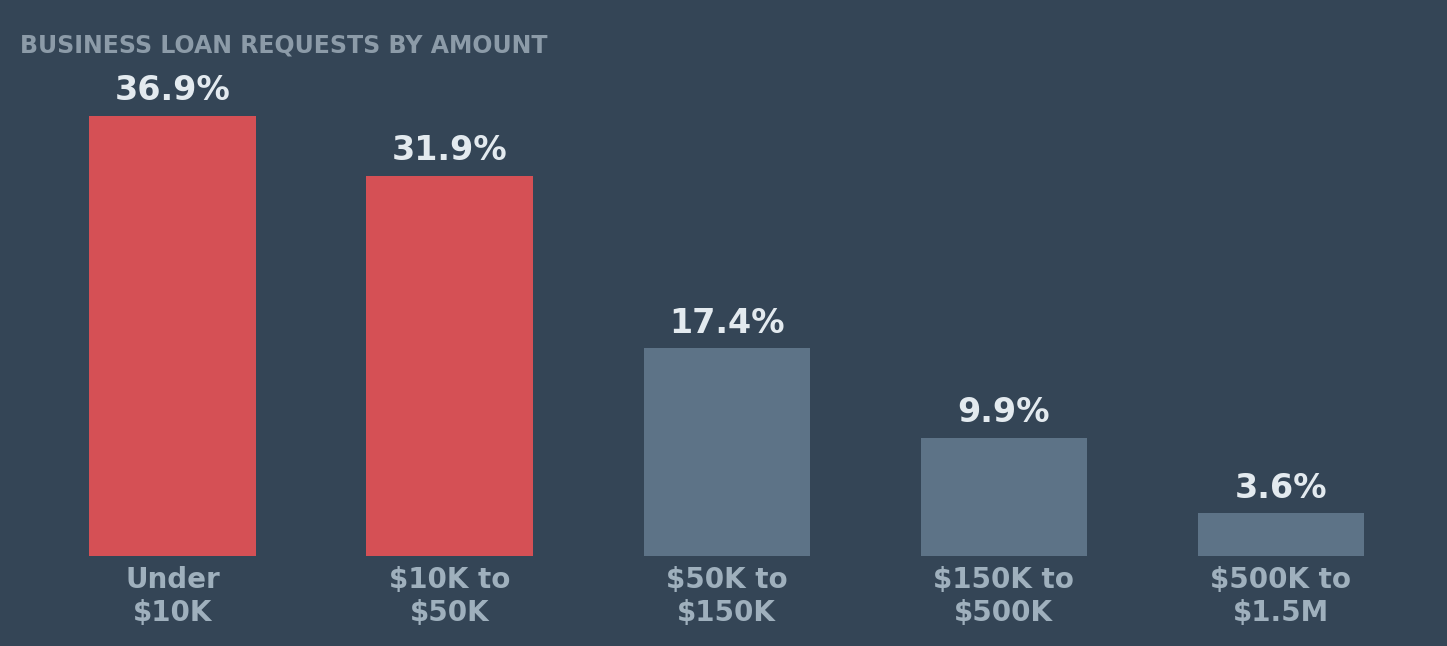
Use the figures below to size your request, and split it: the equipment part goes on equipment terms, the operating part on a working capital product. A single number that mixes the two is priced as the more expensive of them.
| Request size | Share of business demand |
|---|---|
| Under $10,000 | 36.9% |
| $10,000 to $50,000 | 31.9% |
| $50,000 to $150,000 | 17.4% |
| $150,000 to $500,000 | 9.9% |
| $500,000 to $1.5 million | 3.6% |
Across all business applications on Smarter Loans from January 2026 to June 2026, 68.8% of requests were for under $50,000 and 36.9% for under $10,000. Everyday operations borrowing averaged $89,090 and inventory $78,083, both below the overall business average of $94,465. Businesses reporting $100,000 to $249,000 in annual revenue asked for $49,956, and businesses under two years old, which are 31.1% of all applications, asked for $82,937. Salon and spa applications are inside that pattern: small, short, and mostly for operating gaps, with the larger amounts sitting on the equipment side.
Spas carry the heaviest equipment load in the category and the strongest case for financing it separately. A spa borrowing working capital for a device is the sector's most common mispricing.
Barbershops are the closest to a cafe in pattern of deposits: high frequency, small ticket, very regular. They read well to lenders who lend against your sales and often better than their size suggests.
Nail salons and lash studios sit between the two, with modest equipment and card-heavy service revenue. Loans repaid from your sales fit; term debt opens up after a year of statements.
Mobile and home-based operators have the hardest file, because there is no lease and often no separate business account. Opening one and running six months of deposits through it is the single most useful thing to do before applying.
The Canadian Federation of Independent Business publishes sector conditions for personal services businesses, including the cost pressures every lender here is modelling against: cfib-fcei.ca.
The hardest thing in a salon to finance is the fit-out: plumbing for basins, electrical for devices, flooring, mirrors, lighting. It costs as much as the equipment, sometimes more, and unlike the equipment it has no resale value; it belongs to the landlord the day you leave.
That is why no lender finances build-out against itself. It gets financed one of three ways. As part of a larger term loan, where the equipment and the business's deposits carry the security. Through the landlord, as a tenant improvement allowance or a rent-free period negotiated into the lease, which costs nothing and is asked for far less often than it should be. Or from the owner's own funds, which is how most first salons are actually fitted out.
If you are borrowing for an opening and the number includes fit-out, say so on the application. A lender pricing a $60,000 request that is $25,000 of devices and $35,000 of drywall reads it very differently from $60,000 of devices, and a file that separates the two is a stronger one.
Apply once; the application below reaches every lender listed and routes on what you tell it. Owners with a poor personal credit history should read the bad credit business loans page; the business loan calculator prices any amount as a term loan so you can see the equipment-versus-working-capital gap for yourself. All business financing options are on the business loans hub. Salon and spa applications are too few in our data to report on their own, so the figures below are for all business applications.
Source for all platform figures: Smarter Loans business loan applications, January 2026 to June 2026.
Reviewed by Vlad Sherbatov, Co-Founder and President, Smarter Loans. Last reviewed 4 September 2026. Platform figures cover business loan applications from 1 January to 30 June 2026.
Yes, with limits. Nine of the eleven lenders want six months in business and two accept three. Under six months, expect loans repaid from your sales assessed on card sales, and expect to pay more than an established salon. A separate business account with six months of deposits is the most useful thing a new salon can bring to an application.
Almost always. A $12,000 device financed over 60 months at 9% costs about $2,950 in interest across five years; the same $12,000 on a 1.3 factor advance repaid over eight months costs $3,600 in under a year. Equipment holds value and should be financed against itself; working capital should cover gaps, not purchases.
Yes, and it flips which product fits. Rental income is monthly and predictable, which is what term lenders and line-of-credit lenders want to see. It also means lower card volume, which weakens your application for advance repaid from your saless that read card processing statements. Service-based salons are the reverse.
Across all business applications on our platform in the first half of 2026, 68.8% of requests were for under $50,000 and 36.9% for under $10,000; everyday operations borrowing averaged $89,090. Salon borrowing sits inside that pattern, with the larger amounts on the equipment side, where devices are financed against themselves over several years.
Bank deposits and their rhythm first, then card processing statements for service-based salons, then time in business and remaining lease term, then the owner's credit. Whether you run a rental or a service model decides whether a term lender or a revenue-based lender is the better fit.