One application. 3 lenders.
Get Funded One application routed to where you qualify.
Every Apply button starts the same single application. Your chosen lender is prioritized first.


| Line of credit | Term loan | Merchant cash advance | |
|---|---|---|---|
| Rate range | 7.5% APR | 5.9% APR | Factor 1.1 - 1.5 |
| Interest charged on | Only what you draw | The full amount from day one | A fixed factor on the advance |
| Repayment | Revolving, minimum payment | Fixed payments, set end date | A share of daily card sales |
| Re-borrow without reapplying | Yes | No | Renewal only |
| Best when | Cash-flow gaps that come and go | A sized investment with a payback horizon | Card revenue is steady but assets are thin |
| Watch out for | No end date means a balance can persist | Prepayment terms differ by lender | Factor pricing costs more than the rate suggests |
A business line of credit is a limit rather than a lump sum. You are approved for an amount, you draw what you need when you need it, interest runs on the drawn balance only, and the limit refreshes as you repay. Draw $8,000 against a $50,000 line and you pay interest on $8,000, not $50,000.
That structure suits one situation specifically: a need that recurs or cannot be predicted. Seasonal inventory. A receivable that lands three weeks late. Payroll across a thin month. For a single known purchase, a term loan is usually cheaper and forces a payoff date; a line does not.
Three lenders offer a true revolving line, and one application reaches all three. A lender that declines you for a line will often approve a term product instead; those are on the business loans hub.
The route depends on how long you have been trading and what your financials look like.
With two or more years of trading and reviewed financial statements, start at your bank or credit union. Bank lines are the cheapest revolving credit a business can hold, and they are also the hardest to get: banks want statements, a personal guarantee, and usually security.
With six to eighteen months in business and a healthy bank account, the lenders are built for you. They read deposits rather than statements, decide in days rather than weeks, and price above the bank for the privilege.
Under six months, a line is rarely on offer from anyone. Expect a short-cycle advance or working capital product first, and refinance into a line once you have a clean repayment on record. See working capital loans for what fits a gap under six months.
Across our platform, the average business applying for financing has been trading 7.5 years, but 31.1% of applications come from businesses under two years old. That younger third is who these lenders were built for.
Whichever route, you apply once. The step-by-step guide to qualifying covers the documents.
Line products carry stricter floors than one-time advances, because the lender is committing to lend repeatedly.
Time in business. Two of the three want twelve months in business. One accepts six. That is tighter than the wider page, where several lenders fund at three to six months for term loans. A revolving facility wants to see a full year of deposits before it trusts the pattern.
Monthly revenue. The lowest floor on a line product here is $5,000 a month. The others want $10,000. Consistency matters more than the total. A lender would rather see the same $10,000 land every month than $30,000 arrive four times a year.
Existing commitments. Lenders see every recurring debit in your account. A line drawn beside an outstanding advance counts as stacking, and stacking is the most common reason a business application is declined.
Owner credit. It sets the rate and the tier rather than the decision. In the first half of 2026, 49.6% of business applicants on our platform carried no usable personal credit score and a further 24.4% sat in the fair band. Lenders serving this market are built for those files. The bad credit business loans page goes into what that means for approval.
The limit follows your deposits, not the amount you ask for. Lines generally open smaller than an equivalent term approval and increase with demonstrated use and clean repayment. Asking for $100,000 on $12,000 a month of deposits gets you a smaller line, not a decline.
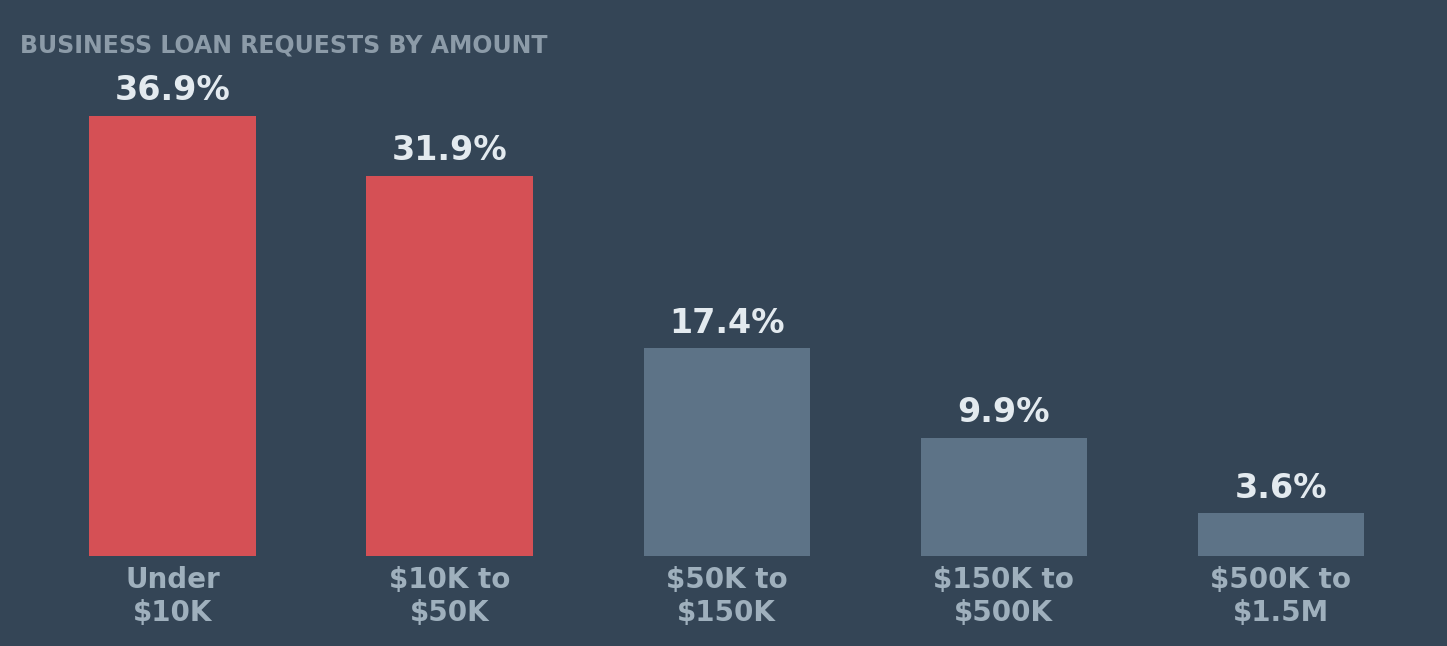
Where businesses actually sit, from our platform in the first half of 2026:
| Request size | Share of business demand |
|---|---|
| Under $10,000 | 36.9% |
| $10,000 to $50,000 | 31.9% |
| $50,000 to $150,000 | 17.4% |
| $150,000 to $500,000 | 9.9% |
| $500,000 to $1.5 million | 3.6% |
68.8% of business requests are for under $50,000 and 36.9% for under $10,000. Businesses reporting $100,000 to $249,000 in annual revenue asked for $49,956 on average; businesses trading five years or more asked for $108,510. The overall average of $94,465 is pulled up by a small number of large requests. A line sized to your deposits will usually land inside the smaller of those numbers.
The lender can reduce or withdraw the limit. This is the material difference from a term loan, whose terms are fixed at signing. Revolving facilities are reviewed, usually annually, and a review after a weak quarter can cut the limit exactly when you most need it. Businesses that rely on a line as their only contingency have discovered this at the worst moment. Keep the line as one option, not the only one.
An unused line usually costs nothing beyond any annual or inactivity fee. Confirm which fees apply before signing; they vary between the three.
Rates on these lines start at 7.99% with two lenders and 19.99% with a third. Two of the three lenders publish 7.99% and one publishes 19.99%, and the gap does not track any single criterion you can read off a card. What sets your rate within a lender's range is deposit strength over the last six months and whether other debt is already debiting the account.
Bank lines price below that range for businesses that qualify, and the gap is the cost of speed and of being assessed on deposits rather than statements. If you can clear a bank's criteria, do; if you cannot yet, this page is the honest alternative rather than a substitute.
Two things move your rate within a lender's range: deposit consistency across the last six months, and whether there is any other debt debiting the same account.
The rate is only part of it. The structure decides most of the cost, and a worked example shows why a line beats the alternatives for short, recurring gaps.
Take a $20,000 draw held for sixty days at 12% APR. Interest is roughly $395, and it stops when you repay.
The same $20,000 as a twelve-month term loan at 12% costs roughly $1,320 in interest, because you carry the full balance from day one and pay it down on a schedule whether you needed it that long or not.
The same $20,000 as a merchant cash advance at a factor of 1.25 costs $5,000, fixed at the outset, and repaying early saves nothing. Our merchant cash advance page works through why.
That is the case for a line: for a gap that closes in weeks, it is the cheapest structure by a wide margin. The case against it is the mirror image. A line carried at the minimum payment for years costs more in total than a term loan on the same amount would have, because nothing forces it to zero. The business credit line calculator models both.
A large share of searches for a business line of credit are for a specific bank's product. That is the right first stop if you qualify, and the honest picture is this.
Bank lines are cheaper and larger, secured against business or personal assets, and assessed on financial statements. Approval takes weeks. The bank will want to see two years of reviewed statements for anything above a small limit.
Online lender lines, which is what this page lists, are assessed on bank deposits, approved in days, unsecured beyond a general security agreement and a personal guarantee, and priced higher for all of that. They exist for the business the bank has not said yes to yet.
Many businesses hold both: a bank line for the base and an online line for the overflow, or an online line for the first year and a bank line once the statements support it. Neither is wrong. What is wrong is paying online-lender rates on a balance a bank would have carried for less.
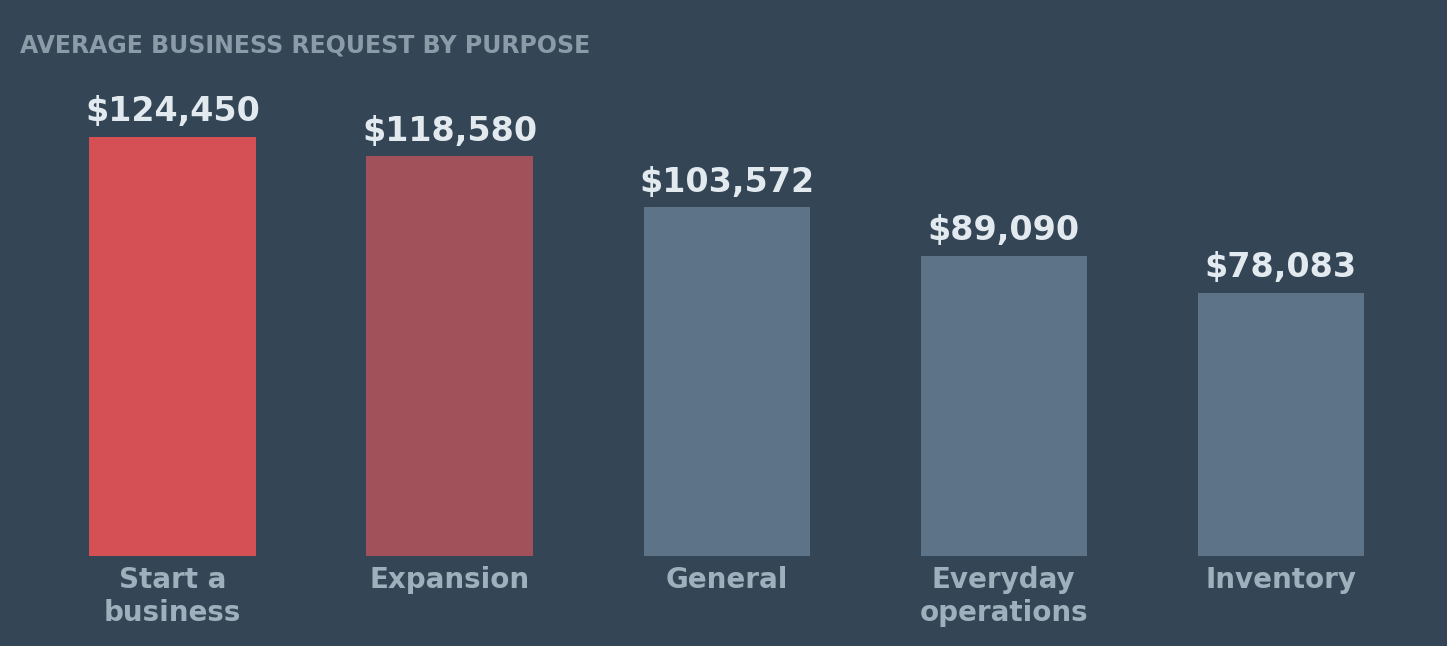
Purpose matters too. Across our platform, everyday operations borrowing averages $89,090 and inventory $78,083:
| Stated purpose | Average request |
|---|---|
| Start a business | $124,450 |
| Expansion | $118,580 |
| General business | $103,572 |
| Everyday operations | $89,090 |
| Purchase inventory | $78,083 |
Both of those are line-shaped needs. A start-up or expansion request, which averages well above them, is usually a term-loan need, and a line is the wrong instrument for it. Three cards is the true count: three listed lenders hold a revolving product, and this page does not pad the list with term lenders.
Source for all platform figures: Smarter Loans business loan applications, 1 January to 30 June 2026.
If your need is a one-time purchase, a term loan is the better structure. If your gap is entirely timing on invoices already issued, invoice factoring may fit better than either. Our guide to secured and unsecured business loans covers the security side. The Financial Consumer Agency of Canada explains how lines of credit work in general terms.
Reviewed by Rafael Rositsan, Co-Founder and CEO, Smarter Loans. Last reviewed 2 September 2026. Platform figures cover business loan applications from 1 January to 30 June 2026.
It is a limit rather than a lump sum. You draw what you need, pay interest only on the drawn balance, and the limit refreshes as you repay. It suits recurring or unpredictable gaps such as seasonal inventory or a late receivable. For a single known purchase a term loan is usually cheaper.
With two or more years of trading and reviewed statements, start at your bank. With six to eighteen months and a healthy bank account, the online lenders assess deposits instead of statements and decide in days. Under six months, expect a short-cycle product first and refinance into a line after a clean repayment.
Rates on these lines start at 7.99% with two lenders and 19.99% with the third. Bank lines price below that for businesses that qualify. Your rate within a lender's range is set by deposit consistency and by whether other debt is debiting the same account.
Yes. Revolving facilities are reviewed, usually annually, and can be reduced or withdrawn after a weak period. That is the main risk of relying on a line as your only contingency, and the main difference from a term loan, whose terms are fixed at signing.
For a recurring or seasonal gap that closes in weeks, yes, by a wide margin: a $20,000 draw held sixty days at 12% costs roughly $395, against roughly $1,320 for the same amount as a twelve-month term loan. For a one-time purchase carried for the full term, the term loan is cheaper and forces a payoff date that a line does not.