




On this page
What a consolidation loan actually replaces
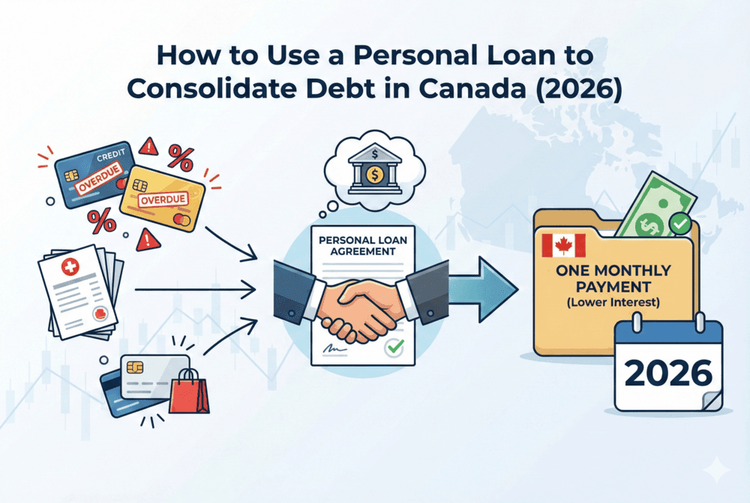
A debt consolidation loan is an ordinary personal loan used for one specific job: paying off several balances at once so that what is left is a single instalment with a fixed rate, a fixed payment and a known end date. Nothing is forgiven. The total you owe on the day after consolidating is the same total you owed the day before, minus whatever the loan proceeds cleared and plus whatever the loan costs.
That is the whole mechanism, and it is worth being precise about it, because the word "consolidation" gets used for four different things that behave very differently. A consolidation loan is one of them. A line of credit, a balance transfer card and a consumer proposal are the other three, and only the last of those reduces what you owe.
What consolidating changes is the price and the shape of the debt. The price falls if the new rate is lower than the blended rate you are paying now. The shape changes from several revolving balances with no end date into one amortising loan that finishes. For most people the second part matters as much as the first, because a credit card balance at the minimum payment has no visible finish line and a five-year loan does.
The one test that decides it. Consolidating saves you money only when the new rate beats the weighted average of the rates you are paying now, not the highest one. Clearing a card at 19.99% with a loan at 11% is a saving. Rolling a 4% student loan into the same package is not, and doing both at once can wipe out the gain. Work it out on the balances you actually intend to move.
What Canadians borrow to consolidate
Consolidation borrowers ask for meaningfully more than other personal loan applicants. Across Smarter Loans personal loan applications from August 2025 to July 2026, the average amount requested where the stated purpose was debt consolidation was $6,659, against $2,262 across all other personal loan purposes in the same period.
That gap is close to three to one, and it is a straightforward consequence of what the loan is for. A borrower funding a repair or a purchase is sizing the loan to one expense. A borrower consolidating is sizing it to the sum of several balances that have been accumulating, often for years. It also explains why consolidation applications get more underwriting attention than their size alone would suggest: a larger request against the same income is a larger monthly payment against the same budget.
The credit score lenders want
There is no single cut-off. What the data shows is that the amount people ask for climbs sharply with the credit band they sit in, which is a different thing from approval and worth understanding separately.
| Under 560 | $5,529 |
| 560 to 659 | $6,866 |
| 660 to 724 | $10,227 |
| 725 and above | suppressed, fewer than 100 applications |
Source: Smarter Loans personal loan applications, August 2025 to July 2026.
Read that from the bottom up. Applicants under 560 ask for the least, not because they owe the least, but because the offers available to them are smaller and they size the request to what they expect to get. The 660 to 724 band asks for roughly double what the under-560 band asks for. The 725-and-above band is suppressed here because fewer than a hundred applications fell into it in the period. That is a suppression, not a zero, and no conclusion should be drawn about that band from its absence.
For approval itself, three things carry the decision, in this order: whether your income is documented and stable, what share of it is already committed to debt payments, and where your credit sits. Fair credit gets approvals, at a higher rate. Poor credit narrows the field to lenders who specialise in it rather than closing the door. If your score is the obstacle, the practical move is to fix the cheapest thing first, which is usually utilisation, and our guide to consolidating debt with a personal loan covers what lenders check in detail.
Does consolidating save you money?
Run it as arithmetic, not as a feeling. You need four numbers.
- Your current blended rateList every balance you intend to move with its rate. Multiply each balance by its rate, add those up, divide by the total balance. That percentage is what the new loan has to beat, not your worst card.
- The total, including feesAdd the balances, plus any early-payoff penalty on the debts you are clearing, plus the origination fee on the new loan. That sum is what you need to borrow, and it is the figure the saving is calculated on.
- The new rate you actually qualify forNot the advertised rate. Compare on annual percentage rate so mandatory fees sit inside the number, then ask what your rate would be given your profile.
- Total interest, old versus newInterest over the remaining life of the current balances against interest over the full term of the new loan. A lower rate over a longer term can still cost more in total. That is the trap.
The debt payoff calculator does the fourth step for you if you have the first three.
What Canadians ask for, by province
Where you live changes the number more than most people expect. In Smarter Loans personal loan applications from August 2025 to July 2026, the average consolidation request ranged from just over $6,100 to just under $8,000 depending on the province.
| Newfoundland and Labrador | $7,948 |
| Saskatchewan | $7,123 |
| Ontario | $6,920 |
| Manitoba | $6,491 |
| Alberta | $6,402 |
| British Columbia | $6,392 |
| Nova Scotia | $6,349 |
| Quebec | $6,224 |
| New Brunswick | $6,133 |
| NT, NU, PE and YT | suppressed, fewer than 100 applications each |
Source: Smarter Loans personal loan applications, August 2025 to July 2026.
Four jurisdictions, Northwest Territories, Nunavut, Prince Edward Island and Yukon, are suppressed above because each had fewer than a hundred applications in the segment. They are suppressed, not zero. The national average across the same period was $6,659, for Smarter Loans personal loan applications from August 2025 to July 2026.
How to compare an offer
Four products get called debt consolidation. They behave differently enough that picking the wrong one is more expensive than picking a slightly worse rate on the right one.
| Route | How it works | Best when | The catch |
|---|---|---|---|
| Consolidation loan | Fixed amount, fixed rate, fixed term. Proceeds clear the old balances. | You want a definite end date and a payment that cannot drift. | You are committed to the term; early repayment may carry a charge. |
| Line of credit | Revolving. You draw what you need and pay interest only on the drawn amount. | Your balances fluctuate and you value flexibility over certainty. | No end date. Revolving credit is what created the problem for most people. |
| Balance transfer card | Promotional rate, often near zero, for a fixed window. A transfer fee usually applies. | The balance is modest and you can clear it inside the promotional window. | The rate reverts, often above 20%. Anything left when it does is expensive. |
| Consumer proposal | A legally binding arrangement, filed through a Licensed Insolvency Trustee, to repay part of what you owe. | The debt is genuinely unpayable, not merely inconvenient. | It reduces the balance, and it stays on your credit file for years. It is insolvency, not borrowing. |
Once you have chosen the route, compare offers on four things and in this order: annual percentage rate, total interest across the full term, the fees named in writing, and whether the payment survives a bad month rather than an average one. A lender that will not give you the fee schedule before you commit has told you something useful.
Frequently asked questions
What is the best debt consolidation program in Canada?
There is no single best programme, because the right route depends on whether your debt is expensive or unpayable. If you can service the balances and the problem is the interest rate, a consolidation loan or a balance transfer is the cheaper answer. If you cannot service them at all, a consumer proposal through a Licensed Insolvency Trustee is the route designed for that, and it works differently. It reduces what you owe and it stays on your file. Anyone offering a single answer without asking which situation you are in is selling, not advising.
Which banks offer debt consolidation loans?
Every major Canadian bank will lend for consolidation, usually as an ordinary personal loan rather than a separately branded product, and so will credit unions and a large number of online lenders. Banks tend to price best for strong credit and longer relationships; credit unions are often competitive on rate; online lenders are usually faster and will consider profiles the banks decline, at a higher rate. The practical approach is to compare across all three rather than start with your own bank and stop there.
What are the requirements for a personal loan to consolidate debt in Canada?
Documented, stable income; a debt-to-income ratio that still works once the new payment is included; and a credit profile the lender will price. Most lenders will want government identification, proof of income, and recent bank statements. Some will ask what the balances are and confirm the loan is clearing them. You do not usually need collateral for a consolidation loan, though a secured option will normally be cheaper if you have an asset to offer.
How much can I borrow for a debt consolidation loan?
Enough to clear the balances you are consolidating, provided the resulting payment fits your income and debt ratios. That is the real constraint, not a product maximum. For scale, the average request across Smarter Loans personal loan applications for consolidation from August 2025 to July 2026 was $6,659, though the range behind that average is wide and the amount you qualify for depends on your own income and existing obligations.
Sources
- Financial Consumer Agency of Canada, consolidating your debt, for the definition of each route and the consumer-proposal distinction.
- Bank of Canada, policy interest rate, for the rate environment personal loan pricing moves with.
- Smarter Loans personal loan applications, August 2025 to July 2026, for every first-party figure on this page. Each figure carries its own source line and period.
Related reading: how to consolidate debt with a personal loan and how debt consolidation works in Canada.

 Written by:
The Smarter Loans Editorial Team produces in-depth, original content to help Canadians navigate borrowing, credit, and personal finance with confidence.