




On this page
What debt consolidation is, and is not
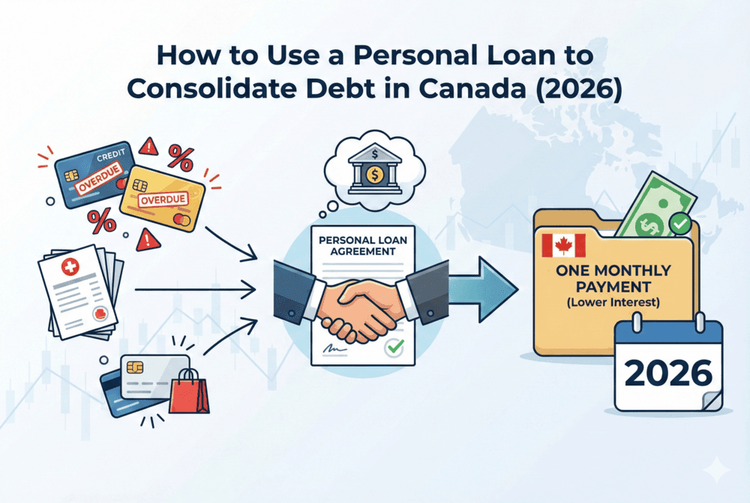
Debt consolidation means replacing several debts with one, so that instead of five due dates, five minimum payments and five interest rates, you have a single payment at a single rate with a date it finishes. The most common way to do it is a debt consolidation loan, though it is not the only way.
Here is the part that matters most and gets stated least: consolidation does not reduce what you owe. It reprices the debt and it reshapes it. The morning after you consolidate, the total on your balance sheet is the same as the night before, minus what the proceeds cleared and plus what the new loan costs. If the new rate is lower than the blended rate you were paying, you save money over time. If it is not, you have simply moved the debt.
That distinction is the whole reason people confuse consolidation with a consumer proposal, which is a different thing entirely and does reduce the balance. The two get discussed in the same breath because both are answers to "I owe too much", but they answer different versions of that sentence. One for debt that is expensive, one for debt that is unpayable.
The test that separates them. Ask whether you could clear the balances given enough time at a fair interest rate. If the answer is yes, the problem is the rate, and consolidation is the tool. If the answer is no, if the arithmetic does not close at any rate, the problem is the amount, and no amount of borrowing fixes it. That is what insolvency law exists for.
What happens to your credit score
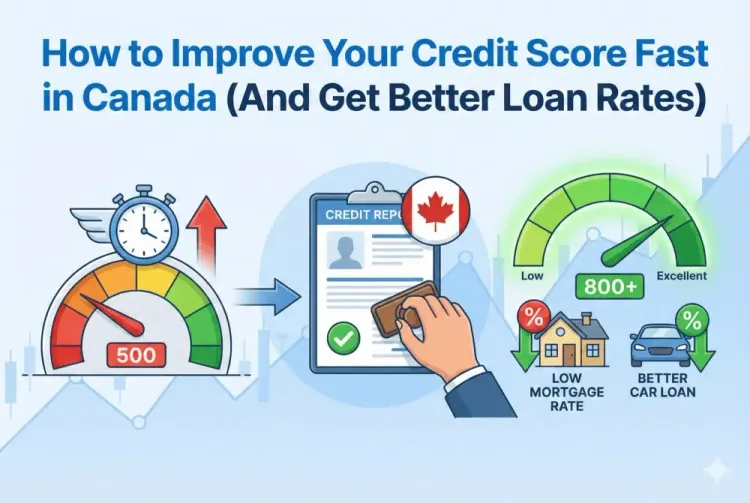
Consolidating moves your score in two directions at two different speeds, which is why people get contradictory answers about it.
The short-term dip. Applying triggers a hard inquiry, which typically costs a small number of points and fades within a year. Opening a new account also lowers the average age of your credit file, which is a modest, temporary drag. Together these are real but small, the sort of movement that matters if you are about to apply for a mortgage next month and does not matter otherwise.
The recovery, and why it usually overshoots. Credit utilisation, how much of your available revolving credit you are using, is one of the heaviest factors in a Canadian credit score. Paying five card balances down to zero with a consolidation loan collapses your utilisation, because instalment debt is not counted in that ratio the way revolving debt is. That effect is normally larger than the inquiry cost, and it starts showing up as the accounts report over the following one to three months.
Then the third factor takes over: payment history, the single biggest input. A consolidation loan paid on time every month is a clean, lengthening record of exactly the behaviour scoring models reward. The dip is a few points for a few months. The recovery, if you do not refill the cards, compounds for years.
The four routes
Four different products get described as debt consolidation. They are not interchangeable, and choosing the wrong shape costs more than accepting a slightly worse rate on the right one.
| Route | What it does | Suits | Watch for |
|---|---|---|---|
| Consolidation loan | A fixed-rate instalment loan. Proceeds clear the old balances; you repay over a set term. | Most people, most of the time, especially where a definite end date is the point. | You are committed to the term. A longer term at a lower rate can still cost more in total interest. |
| Line of credit | Revolving credit. You draw what you need; interest applies only to the drawn balance. | Borrowers with strong credit and fluctuating balances who genuinely value flexibility. | No end date, and revolving access is what created the problem for a lot of people. |
| Balance transfer card | Moves card balances to a promotional rate, often near zero, for a fixed window. A transfer fee usually applies. | A modest balance you can realistically clear before the promotional period ends. | The reversion rate, frequently above 20%. Whatever is left when the window closes gets expensive fast. |
| Credit counselling | A non-profit agency negotiates a debt management programme with your creditors, often reducing or freezing interest. | Someone who cannot get an affordable rate but is not insolvent. | It is noted on your credit file, and it requires the creditors to agree. Check the agency is a genuine non-profit. |
Consumer proposal versus consolidation
A consumer proposal is not a fifth route on that table, because it is not borrowing. It is a formal insolvency proceeding under federal law, filed through a Licensed Insolvency Trustee, in which you offer your unsecured creditors repayment of part of what you owe over a period of years. If the required majority accepts, the rest is legally extinguished and every creditor is bound, including the ones who voted against.
| Consolidation loan | Consumer proposal | |
|---|---|---|
| What happens to the balance | Unchanged. Repriced, not reduced. | Reduced. You repay an agreed portion. |
| Who administers it | A lender. It is an ordinary credit product. | A Licensed Insolvency Trustee, under the Bankruptcy and Insolvency Act. |
| Effect on your credit file | A new account. Small dip, then usually recovery. | A serious, lasting entry that remains for years after completion. |
| Creditor participation | None needed. You simply pay them off. | Required. Creditors vote, and the outcome binds all of them. |
| When it is the right answer | The debt is serviceable but expensive. | The debt cannot be serviced at any realistic rate. |
People often ask which is the alternative to bankruptcy. A consumer proposal is. It is the route most Canadians use instead of filing for bankruptcy, and it lets you keep assets that bankruptcy would not. Consolidation is not an alternative to bankruptcy; it is something you do while you are still solvent. Reaching for a larger loan to stay ahead of debt you cannot carry makes the eventual landing harder, and it is worth being honest with yourself about which situation you are in before you borrow.
What Canadians ask for, by province
How much Canadians borrow to consolidate varies quite widely by province, with a spread of roughly $1,800 between the highest and lowest provincial averages.
| Newfoundland and Labrador | $7,948 |
| Saskatchewan | $7,123 |
| Ontario | $6,920 |
| Manitoba | $6,491 |
| Alberta | $6,402 |
| British Columbia | $6,392 |
| Nova Scotia | $6,349 |
| Quebec | $6,224 |
| New Brunswick | $6,133 |
| NT, NU, PE and YT | suppressed, fewer than 100 applications each |
Source: Smarter Loans personal loan applications, August 2025 to July 2026.
Newfoundland and Labrador sits highest and New Brunswick lowest, against a national average of $6,659 across Smarter Loans personal loan applications from August 2025 to July 2026. Northwest Territories, Nunavut, Prince Edward Island and Yukon do not appear in the table above because each had fewer than one hundred applications in the segment: those four are suppressed, not zero, and nothing should be inferred about them from their absence.
Provincial differences here reflect what people owe and what property and living costs look like locally, not different rules. Consolidation lending is regulated federally and provincially in ways that do not change the arithmetic from one province to the next.
Frequently asked questions
How does debt consolidation work in Canada?
You take one new credit facility, usually a personal loan, large enough to cover the balances you want to combine, and you use the proceeds to pay each of those accounts off in full. What remains is a single payment at a single rate with a known end date. The total owed does not change at the moment of consolidation; what changes is the interest rate applied to it and the structure of repaying it. It saves money when the new rate is below the weighted average of the rates it replaces.
Does debt consolidation affect your credit in Canada?
Yes, in both directions. Applying causes a hard inquiry and a new account, which together produce a small, temporary dip. Then clearing your card balances sharply reduces your credit utilisation, which is one of the heaviest factors in a Canadian score, and consistent payments on the new loan build payment history over time. For most people the recovery is larger than the dip and arrives within a few months.
Does debt consolidation hurt your credit in Canada?
Only briefly, and only if you leave it there. The lasting damage comes from a specific behaviour rather than from consolidating itself: clearing the cards and then running the balances back up, so you finish with the loan and the card debt both. Reduce or freeze the limits on the accounts you have paid off, on the day you pay them off, and that failure mode is closed. Missing payments on the new loan will hurt your score considerably more than the original inquiry did.
What are the alternatives to filing for bankruptcy in Canada?
A consumer proposal is the main one. It is a formal arrangement filed through a Licensed Insolvency Trustee to repay part of what you owe, which binds all your unsecured creditors and lets you keep assets bankruptcy would take. Before that point, a non-profit credit counselling agency can often negotiate a debt management programme that reduces or freezes interest. And if the debt is still serviceable at a fair rate, a consolidation loan may resolve it without any insolvency proceeding at all. Which one applies depends on whether the debt is expensive or genuinely unpayable.
Sources
- Financial Consumer Agency of Canada, consolidating your debt and credit counselling, for the routes described above.
- Office of the Superintendent of Bankruptcy, consumer proposals and Licensed Insolvency Trustees, for how a proposal works and who may file one.
- Smarter Loans personal loan applications, August 2025 to July 2026, for the provincial figures. The figure carries its own source line and period.
Related reading: debt consolidation loans in Canada compared and how to consolidate debt with a personal loan. To test the arithmetic on your own balances, use the debt payoff calculator.

 Written by:
The Smarter Loans Editorial Team produces in-depth, original content to help Canadians navigate borrowing, credit, and personal finance with confidence.