One application. 17 lenders.
Apply Now One application routed to where you qualify.
Every Apply button starts the same single application. Your chosen lender is prioritized first.

















The 35% federal rate cap applies everywhere in Canada, but provinces differ on licensing and lender obligations.
| Province | Rate cap | High-cost credit licensing | Regulator |
|---|---|---|---|
| Alberta | 35% APR | HCC licence for products >=32% APR | Service Alberta, Consumer Protection Act Payday Loans Regulation |
| British Columbia | 35% APR | HCC licence for products >=32% APR | Consumer Protection BC, BPCPA Part 6.1 |
| Manitoba | 35% APR | HCC grantor licences exist | Consumer Protection Office, Manitoba |
| New Brunswick | 35% APR | No separate provincial high-cost credit licensing band; federal 35% APR cap governs | Financial and Consumer Services Commission |
| Newfoundland and Labrador | 35% APR | NL HCC regime recent | Digital Government and Service NL |
| Nova Scotia | 35% APR | None | Service Nova Scotia |
| Ontario | 35% APR | None | Consumer Protection Ontario |
| Prince Edward Island | 35% APR | None | Consumer Services PEI |
| Quebec | 35% APR | Quebec applies extra rules above a threshold rate, including a check that you can afford the payments. | Office de la protection du consommateur |
| Saskatchewan | 35% APR | None | Financial and Consumer Affairs Authority |
| Northwest Territories | 35% APR | None | NWT Consumer Affairs |
| Nunavut | 35% APR | None | Nunavut Consumer Affairs |
| Yukon | 35% APR | None | Yukon Consumer Services |
The first thing to decide is which side of $1,500 you are on, because lenders treat the two as different products. Under $1,500 you are looking at a short advance, usually repaid in one or two payments and priced as a flat fee or a low rate. From $1,500 up you are looking at an instalment loan repaid monthly over one to seven years and priced as an APR. Different lenders, different rules, and the amount you enter on the application decides which ones see it.
Use the figures below to see which side most people are on, then enter the amount you actually need; that number is what routes your application.
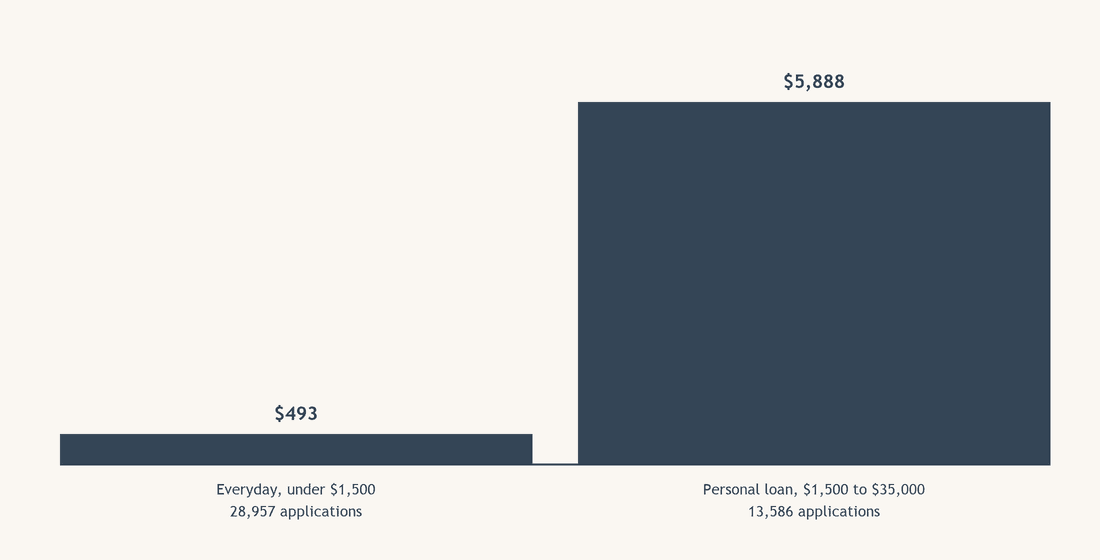
| Segment | Applications | Average request |
|---|---|---|
| Everyday, under $1,500 | 28,957 | $493 |
| Personal loan, $1,500 to $35,000 | 13,586 | $5,888 |
On Smarter Loans, from January 2026 to June 2026, 68% of applications were for everyday amounts under $1,500, and the average request on that side was $493. The other 32% were personal loans between $1,500 and $35,000, averaging $5,888. That is a twelve-fold gap in the amount asked for, and it comes with different lenders, different pricing structures and different qualification rules.
If your need is a few hundred dollars before payday, the advance lenders are the right fit and an instalment lender will mostly not look at you for that amount. If it is a few thousand to clear cards or fix a car, the reverse is true.
Four things, weighted differently by lender, and in an order most borrowers get backwards.
Income type, first. Every one of the seventeen lenders accepts full-time, part-time and self-employed income. Only two publish that they accept benefit income, and the disability loans and child tax benefit loans pages name them. The label you give your income decides which lenders see your application at all, which is why our application asks about income before anything else and why this field eliminates more applicants than credit score does.
Income amount. All seventeen lenders publish a minimum monthly income, and five set it at $1,500, the most common floor on the page. Below the floor nothing else compensates, and above it the floor stops mattering.
Credit band. Twelve of the seventeen lenders approve below 560, and five of those twelve set no minimum band at all and assess banking history instead. On our platform from January 2026 to June 2026, 46.3% of personal loan applicants sat in the fair band (560 to 659), 23.6% were below 560, and 22.1% carried no usable score at all. Good and great credit together were 8%. These lenders are built for the other 92%; the bad credit loans page lists the twelve that say so, and same day loans lists the ones that pay out fastest.
Province. Not every lender operates everywhere. Quebec licenses no lender above a 35% credit rate, which removes conventional payday lending from that province entirely and changes the lender set for everything else.
Income source predicts the amount requested more reliably than anything else on the application.
Use the table below to see what people with your income source typically ask for. A request in line with your income type is the one a lender prices best; one far above it is what pushes you to the top of the range or to a decline.
| Declared income type | Average request, all applications |
|---|---|
| Self-employed | $3,597 |
| Retired | $2,792 |
| Full time | $2,631 |
| Part time | $1,693 |
| Disability income | $1,388 |
| Unemployed | $1,338 |
| Other | $1,159 |
| Social assistance | $720 |
Smarter Loans applications, January 2026 to June 2026, status Applied.
Two things in that table matter for how you apply. Self-employed applicants ask for the most and are the hardest for a bank to assess, which is why several of these lenders read bank deposits instead of employment letters. Applicants on disability income or social assistance ask for the least, and on the everyday side they are a large share of the market: 15.5% of everyday applications declare disability income and 12.5% social assistance, against 49.5% full time. Whether that income counts is a per-lender decision, and our disability loans and child tax benefit loans pages show exactly which lenders say yes.
Age moves the everyday number in one direction only: from $442 for applicants aged 18 to 24, rising through every band to $604 for applicants 65 and over. On the personal loan side, applicants aged 18 to 24 asked for $5,619, close to the overall average.
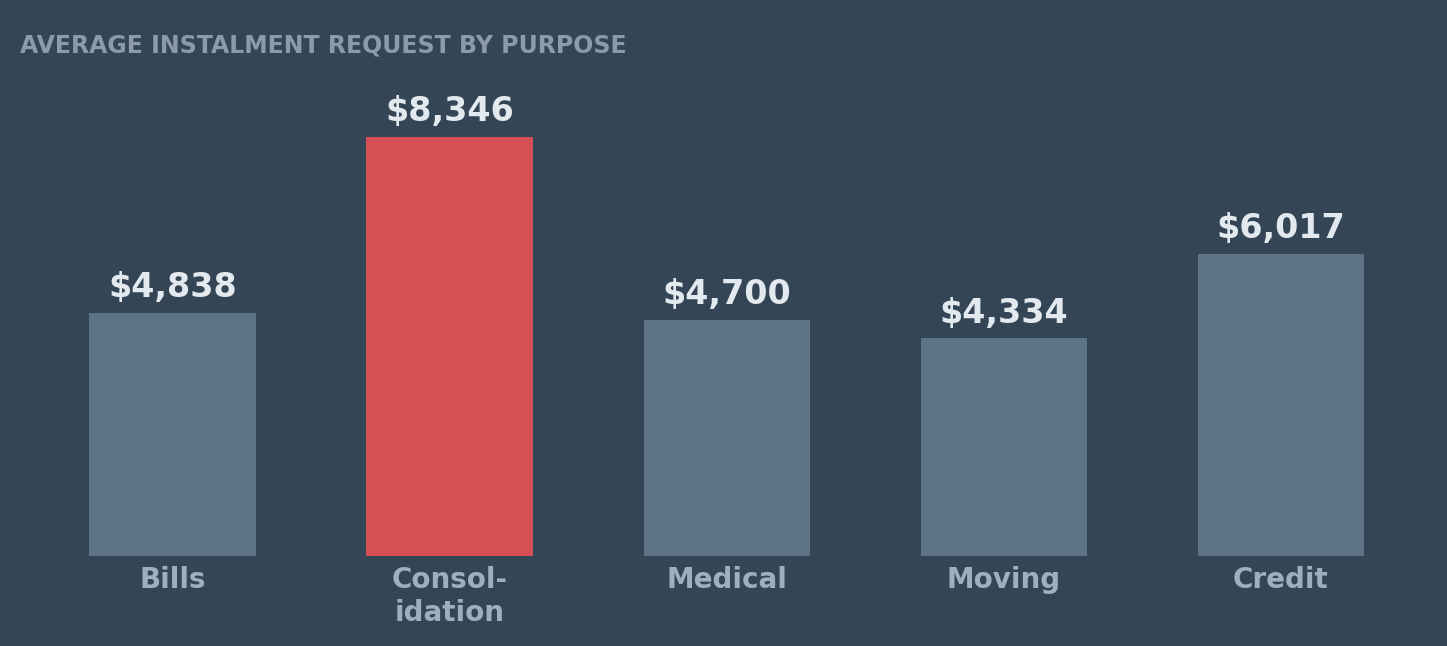
| Purpose | Share of everyday | Everyday average | Share of personal | Personal average |
|---|---|---|---|---|
| Pay off bills | 37.1% | $508 | 33.0% | $4,608 |
| Debt consolidation | 5.1% | $621 | 20.4% | $8,155 |
| Medical expenses | 12.4% | $445 | 5.8% | $4,451 |
| Education | 2.1% | $521 | 2.9% | $6,637 |
| Vacation | 0.5% | $602 | 1.0% | $4,897 |
Purpose cells from the COM-48 release; shares of 29,679 everyday and 13,585 personal applications.
Paying off bills leads both markets, and that is the single most useful fact about personal borrowing: most personal borrowing in Canada is not for something new, it is for something already owed. Consolidation requests average $8,155, the largest in the table above and second only to starting a business across every purpose people state, and it is the one purpose where a lower rate and a longer term change the outcome rather than just the payment; our debt consolidation page works through when it helps and when it only moves the debt. Medical expenses are the third-largest everyday purpose at 12.4%, which is a Canadian fact most people do not expect, and the medical loans page covers what is and is not financeable.
Wedding and event borrowing is 1.3% of personal applications and averages $6,932, well above the $5,888 average across all personal loans. Improve credit, at 4.6%, is the one purpose where the amount matters least and the reporting matters most; see credit building loans.
Every lender is subject to the federal criminal interest rate, 35% APR, in force since 1 January 2025. Where you sit inside that ceiling is set by three things.
Which market you are in. Everyday advances under $1,500 are priced differently from loans. Some are 0% on the smallest amounts, and payday products in every regulated province are capped at $14 per $100 borrowed, which is a fee rather than an interest rate and cannot be compared to an APR by looking at the number. Personal loans from $1,500 up carry an APR, and rates start in the single digits for the strongest applicants and run to the cap for the weakest.
Your credit band. Fair credit, which is 46.3% of personal applicants on our platform, gets the middle of a lender's range. Below 560, which is another 23.6%, gets a rate near the cap, or a lender that assesses banking instead of score. The 8% with good or great credit are the only applicants for whom the bottom of the range is realistic, and they are also the applicants a bank would serve.
Term and amount. A longer term lowers the payment and raises the total. On $8,000 at 24% APR, 24 months costs about $2,150 in interest and 48 months about $4,500. The personal loan calculator runs any combination.
The Financial Consumer Agency of Canada explains how personal loans are regulated and what a lender must disclose before you sign.
Our guide to how loan interest rates are set in Canada covers what moves a rate inside the cap, and how to get a personal loan with bad credit covers the 92% of applicants this page is built for.
Source for all platform figures: Smarter Loans personal and everyday loan applications, January 2026 to June 2026, status Applied.
Reviewed by Rafael Rositsan, Co-Founder and CEO, Smarter Loans. Last reviewed 10 September 2026. Platform figures cover applications from 1 January to 30 June 2026.

When Should You Use a Personal Loan in Canada?
When a personal loan is the right tool and when it is not: what Canadians borrow for, what it costs against a credit card,…
What Canadians Ask For When They Borrow Small
71 percent of more than 79,000 Smarter Loans personal loan applications in the year to July 2026 asked for $1,500 or less. The average request in that range was $552, and it barely moves across income types or provinces.

When Canadians Apply for Loans
Tuesday is the busiest day to apply for a loan at 18.3 percent, across more than 79,000 Smarter Loans applications in the year to July 2026. May is the busiest month at double September, and about a quarter of applications arrive at weekends.

How to Judge a Loan Company in Canada
What separates a reliable loan company from a risky one in Canada: licensing, real APRs, fees in writing, and what borrowers like you get…

How to Find the Best Loan Rates in Canada
How to compare personal loan rates in Canada: APR over advertised rate, total cost over monthly payment, and how to shop without damaging your…
It depends which market you are in. On Smarter Loans from January 2026 to June 2026, everyday requests under $1,500 averaged $493 across 28,957 applications, and personal loans from $1,500 to $35,000 averaged $5,888 across 13,586. Consolidation requests averaged $8,155, the highest of the common purposes; only starting a business, a far rarer purpose, averages more.
35% APR. The federal criminal interest rate came down from an effective annual rate of 60% on 1 January 2025, and every lender is subject to it. Payday products are priced separately, capped at $14 per $100 borrowed in every province that licenses them; Quebec licenses no lender above a 35% credit rate.
Yes. Twelve of the seventeen lenders approve below a 560 credit band, and five of them set no minimum at all and assess banking history instead. On our platform, 23.6% of personal loan applicants are below 560 and a further 46.3% are in the fair band, so these lenders are built for that applicant.
Income type, before credit score. Whether a lender accepts self-employed, part-time, disability or benefit income eliminates more applicants than any other criterion, and most lenders then apply a minimum monthly income, most commonly $1,500. Credit band sets the rate within a lender's range rather than the decision.
The 35% federal cap applies everywhere. Payday lending is capped at $14 per $100 in every province that licenses it, and Quebec licenses no lender above a 35% credit rate, which removes conventional payday lending there and changes the lender set for small borrowing. On our platform, the average personal loan request ranges from $5,591 in Manitoba to $6,180 in Newfoundland and Labrador.