One application. 5 lenders.
Covers semi-trucks and highway units, work and vocational trucks, and trailers. For pickups and light commercial vehicles see auto loans.
Get Funded One application routed to where you qualify.
Every Apply button starts the same single application. Your chosen lender is prioritized first.



| Brand | Typical used price | Financing note |
|---|---|---|
| Freightliner | $45,000 - $130,000 | Largest parts and service network in Canada, which lenders read as lower downtime risk on older units |
| Kenworth | $60,000 - $160,000 | Strong resale means lenders often accept higher loan-to-value on used units |
| Peterbilt | $60,000 - $165,000 | Same resale profile as Kenworth; both are PACCAR |
| International | $40,000 - $120,000 | Lower entry price, so more common in first-truck owner-operator financing |
| Volvo and Mack | $45,000 - $140,000 | Integrated powertrain, so some lenders limit older units on specialty drivetrains |
The truck is the security, and the truck earns the money that repays the loan. Lenders finance commercial trucks differently from cars because of that second fact: they are underwriting an operation, not a purchase, and the questions they ask are about loads, contracts and revenue rather than about you.
What that means in practice is that a lender who would not give an unsecured loan to a one-year-old trucking business will finance a $120,000 tractor for it, because the unit can be repossessed and resold and because the lender can see the revenue it will generate. Every one of the five lenders listed considers owner-operators with poor personal credit. The trade is that the lender's interest is registered on the unit, you cannot sell it until the loan clears, and a missed run of payments costs you the thing your business is.
Terms run up to ten years on a new unit and shorten as the truck ages, because the resale value that secures the loan falls with mileage and hours. A five-year-old tractor gets a shorter term than a new one, and a fifteen-year-old one may not be financeable at all except as a short unsecured loan; our truck repair financing page covers keeping an older unit on the road.
Every class of commercial unit, with the terms following the resale market for each.
Semi trucks and tractor units. The core of the market and the deepest resale pool. Longest terms, lowest rates, new or used.
Heavy-duty trucks. Dump trucks, concrete mixers, vocational units. Financed on the same basis as tractors, with more attention to the body and its configuration, which affects resale.
Medium-duty trucks. Straight trucks, cube vans, tow trucks, delivery units. Shorter working lives than a tractor and shorter terms to match.
Trailers. Dry vans, reefers, flatbeds, tankers. Often financed alongside the tractor as one loan; a reefer's cooling unit is financed as equipment with its own working life.
Used units. Routine. The lender scales the term to the remaining life and will want a mechanical inspection on anything private-sale. For a fleet of several units, the assessment shifts from the trucks to the company; see truck fleet financing.
Yes, and a large share of the searches that reach this page are exactly that. What a lender wants from a first-time owner-operator or a startup is proof of the revenue, since there is no history to read.
A contract or a dedicated lane. The single most useful document. A signed agreement with a carrier or a shipper is revenue a lender can underwrite before the truck has turned a wheel.
Driving history. A licensed driver with years behind the wheel for someone else is a known quantity. Lenders ask.
Down payment. Larger for a first unit, often twenty percent or more. It is the substitute for operating history.
Operating authority in place, or in progress. Your CVOR or provincial equivalent, safety fitness certificate, insurance quote. A lender will not fund a unit that cannot legally run.
Two of the five lenders listed will look at a business after six months; the others want twelve or twenty-four. A brand-new operation with a strong contract and a real down payment is a financeable file with the six-month lenders, at the higher end of their range.
Rates start between 5.5% and 9.99% APR depending on the lender, and where you land inside a lender's range is decided by the unit first and by you second.
The unit. New tractor, deep resale market, long term, bottom of the range. Older unit, specialised body, high hours: rate up, term down.
Down payment. Ten to twenty percent on an established operation, twenty or more on a first unit. The lever you control.
Time in business and revenue. The two lenders at 5.5% both want twelve months or more and $10,000 a month. A six-month operation is financed by the lenders that accept it, at their rates.
Your credit. Last. It sets the tier within a lender's range.
A worked example on a $120,000 tractor over 72 months at 7%: about $2,046 a month and $27,303 in interest across the term. Put twenty percent down and finance $96,000 on the same terms, and the payment falls to about $1,637 and the interest to $21,843. The down payment saved roughly $5,500 in interest and, on a first unit, is usually what gets the application approved at all. The truck loan calculator runs any combination.
| Lender | Minimum monthly revenue | Minimum months in business | Published term range |
|---|---|---|---|
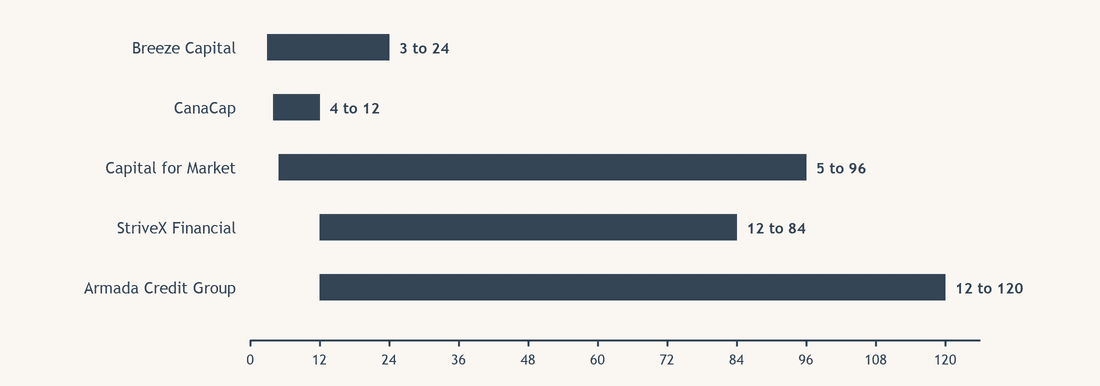
| Breeze Capital | $10,000 | 6 | 3 to 24 months |
| CanaCap | $10,000 | 6 | 4 to 12 months |
| Armada Credit Group | $10,000 | 12 | 12 to 120 months |
| Capital for Market | $8,333 | 12 | 5 to 96 months |
| StriveX Financial | $10,000 | 24 | 12 to 84 months |
Time in business. Two lenders accept six months, two want twelve, one wants twenty-four. The ten-year terms come from the twelve-month lenders; the six-month lenders write shorter loans decided on bank deposits.
Monthly revenue. Four of the five want $10,000 a month; one accepts $8,333. Settlement deposits from carriers and brokers are what they read, and they read them for regularity.
The unit. Year, make, model, mileage and hours, and a quote or bill of sale. Lenders finance the specific truck, and its age and condition set the term.
The operation. Operating authority, insurance, and for a first-time buyer the contract or lane that will produce the revenue.
Owner credit is checked, because nearly every truck loan carries a personal guarantee, and it sets the tier. On our platform in the first half of 2026, 49.6% of business applicants carried no usable personal credit score and 24.4% were in the fair band; the lenders listed finance trucks for that population every day, because the truck is the security. If your credit is the main concern, bad credit truck financing covers what changes.
| Request size | Share of business demand |
|---|---|
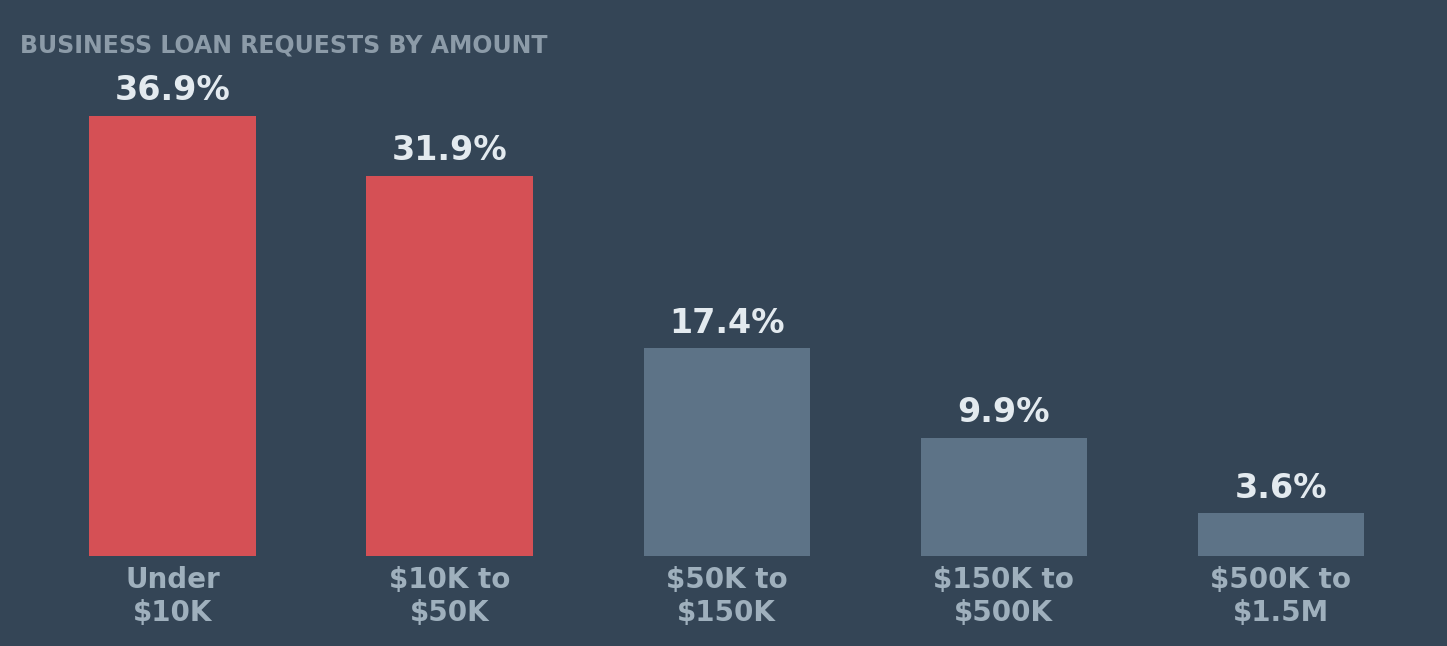
| Under $10,000 | 36.9% |
| $10,000 to $50,000 | 31.9% |
| $50,000 to $150,000 | 17.4% |
| $150,000 to $500,000 | 9.9% |
| $500,000 to $1.5 million | 3.6% |
Use the figures below to check a request against what other businesses ask for, then set yours to the unit's price and your down payment rather than to a round number. Across all business applications on our platform in the first half of 2026, 68.8% were for under $50,000 and 13.5% for more than $150,000, which is where a new tractor sits. Businesses under two years old, which are 31.1% of applications, asked for $82,937 on average; businesses trading five years or more asked for $108,510. A first-time buyer financing one unit is in the first group, and the figures say that is a common file, not a rare one.
Truck purchases are not broken out as their own purpose in our data, so those figures cover all business borrowing.
Source for all platform figures: Smarter Loans business loan applications, January 2026 to June 2026, status Applied; request-size shares from the Smarter Loans Lending Demand Index, first half 2026.
Ontario operators can see the same lenders on the Ontario truck financing page. Trailers and other equipment are on the equipment financing page, and every other business product is on the business loans page.
Reviewed by Rafael Rositsan, Co-Founder and CEO, Smarter Loans. Last reviewed 14 September 2026. Platform figures cover business loan applications from 1 January to 30 June 2026.

Equipment Financing in Canada: How It Works
How Canadian businesses finance equipment, why the asset itself usually secures the loan, what lenders check, and when leasing beats buying.
How Canadian Businesses Borrow: Purpose and Province
Canadian businesses asked for an average of $92,806 across 823 Smarter Loans business loan applications in the year to July 2026. Expansion carried the largest requests at $128,450 and Quebec the highest provincial average at $109,849.

Secured vs Unsecured Business Loans in Canada
What business lenders take as security, what unsecured costs instead, and which fits at your revenue and stage.
The lender finances a specific unit and registers its interest in the truck as security, then underwrites the operation that will repay it: your contracts, settlement deposits and operating authority. Terms run up to ten years on a new tractor and shorten with age. Rates start at 5.5% with these lenders, and every lender listed considers owner-operators with poor personal credit because the truck is the security.
Yes. Two of the five lenders listed will look at an operation after six months, and a brand-new one with a signed contract or dedicated lane, a licensed driver with history, operating authority in place and a down payment of twenty percent or more is a financeable application at the higher end of their range. The contract is the document that matters most.
Ten to twenty percent on an established operation, twenty or more on a first unit. It is the lever that moves both approval and rate: on a $120,000 tractor at 7% over 72 months, twenty percent down saves roughly $5,500 in interest and is usually what gets a first-time application approved.
Yes. The term is scaled to the unit's remaining working life, so a five-year-old tractor gets a shorter loan than a new one, and a very old unit may only be financeable as a short unsecured loan. For a private sale every lender listed will want a mechanical inspection and a lien search before funding.
Yes, more readily than an unsecured loan, because the truck is the security and the lender underwrites the operation's revenue. Every lender listed considers owner-operators with poor credit. Credit sets where you land within a lender's rate range; a larger down payment and a signed contract offset it.